
SOLUTIONS — MECHANICAL CONVEYING
Screw Conveyors
Rigid U-Trough and Tubular Systems—Designed and Fabricated In-House
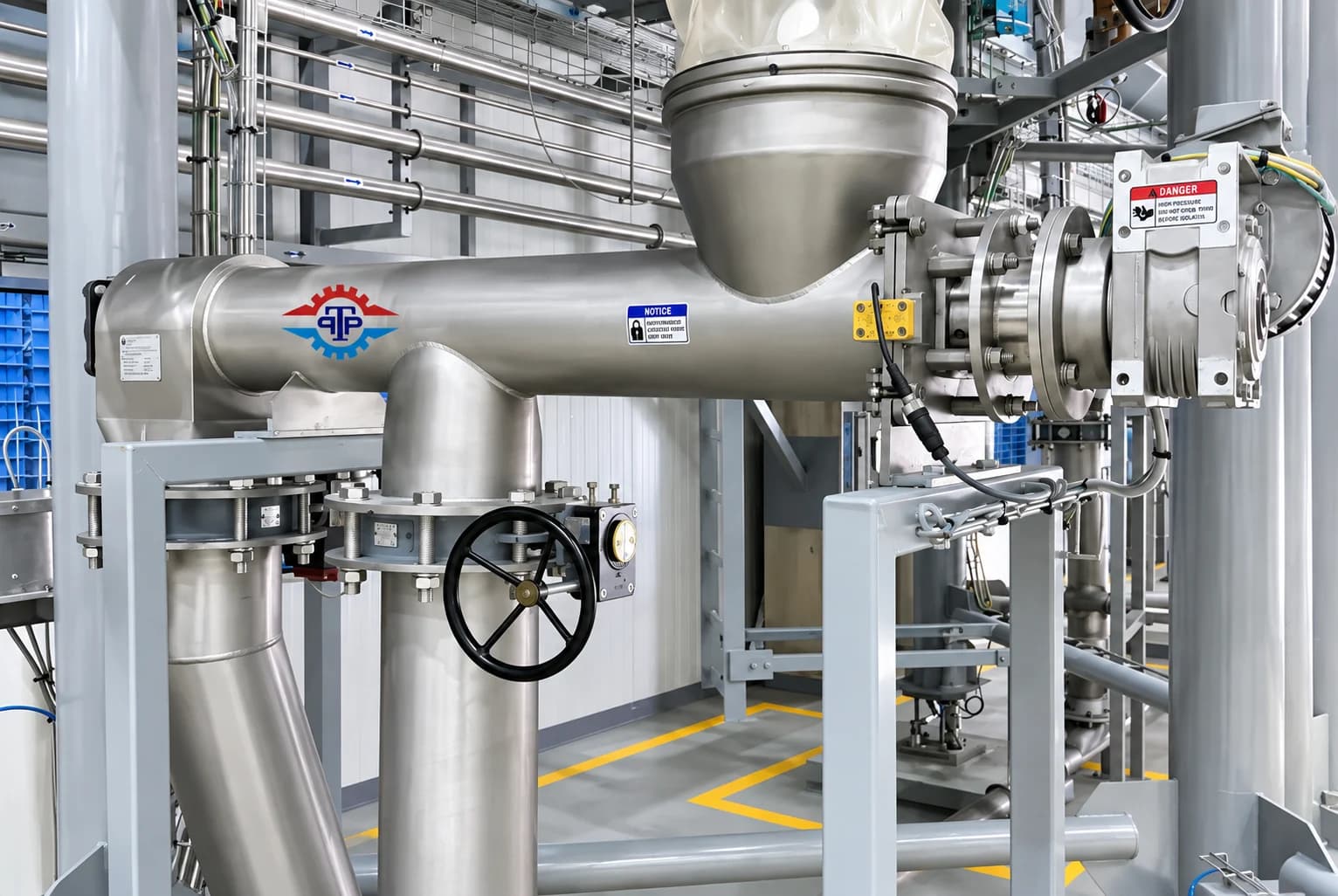
At Paul Techno Process (PTP), we engineer, fabricate, and deliver heavy-duty screw conveyors tailored for food and non-food manufacturing processing lines. Our in-house fabrication capabilities allow us to customize every geometry—offering open U-troughs for versatile inspection and controlled dosing, as well as enclosed tubular designs for dust-tight transfers and inclined elevation.
In short
A screw conveyor transfers bulk materials along a trough or tube using a rotating helical auger flight. Because product is moved mechanically rather than via pneumatic air, throughput is governed directly by rotational screw speed. This renders performance largely independent of the material's inherent flow characteristics, making screw conveyors an exceptionally reliable metering and feeding device.
In detail
How it works.
A screw conveyor is a helical flight turning inside a trough or tube. The flight pushes material along as it rotates, and because the relationship between screw speed and volumetric throughput is close to linear, the same machine that conveys can also meter. That is why so many batching lines end in a screw feeder rather than a conveyor.
The U-trough form is open-topped under a bolted or hinged cover. It is easy to inspect, easy to clean and easy to fit with multiple inlets and outlets along its length. Tubular screws are fully enclosed, which suits dusty, hygroscopic or odorous materials, and they will run at steeper inclines than a trough.
Flight geometry does most of the work. Pitch relative to diameter sets the fill and the conveying rate; ribbon flights suit sticky materials that would pack against a solid flight; cut-and-folded or paddle sections mix as they convey; variable pitch draws evenly along a hopper outlet instead of emptying the near end first.
Incline costs capacity. As the trough angle rises, material falls back over the flight and effective throughput drops, steeply beyond about thirty degrees. Above that, a tubular screw with reduced pitch, or a different conveying method, is usually the right answer.
Hygienic duties change the detail rather than the principle. Food, dairy and pharma screws are built in stainless steel with continuous welds, radiused corners, no dead pockets, end seals chosen for the powder, and covers that come off without tools. PTP builds these to the plant's cleaning regime rather than to a standard catalogue.
Scope
What we engineer and supply.
Selection
How the system gets specified.
- Trough or tube
- U-trough for inspection, multiple outlets and easy cleaning; tubular for contained, dusty or hygroscopic materials and steeper inclines.
- Flight type
- Solid full-pitch for general duty; ribbon for sticky and viscous materials; cut-and-fold or paddle where mixing is wanted; variable pitch under hopper outlets.
- Materials of construction
- Stainless steel 304 or 316 for food, dairy and pharma; mild steel with paint or galvanising for non-contact duties.
- Hygiene detail
- Continuous welds, radiused internal corners, tool-free covers, no dead pockets and seal types chosen for the powder.
- Drives
- Geared motor drives with variable frequency control where the screw doubles as a metering device.
- Options
- Weigh-hopper feeding, load-cell dosing, jacketed troughs for heating or cooling, wear liners and hard-faced flights.
FAQ
Frequently asked questions.
What is the difference between a screw conveyor and a screw feeder?
The machine is the same; the duty is not. A conveyor moves material between two points and runs partly filled. A feeder sits under a hopper or silo outlet, runs full, and controls the rate at which material leaves. Feeders normally use variable pitch to draw evenly along the outlet.
Can a screw conveyor run on an incline?
Yes, but capacity falls as the angle rises because material slips back over the flight. Beyond roughly thirty degrees the loss becomes severe, and a tubular screw with reduced pitch or a different conveying method is usually more economical.
Which materials are unsuitable for a screw conveyor?
Very fragile products that degrade against the flight, highly abrasive materials that would wear the trough quickly, and stringy or fibrous material that wraps a centre shaft. A shaftless screw solves the last case; the first two are often better handled in dense phase.
Are screw conveyors suitable for food and pharma?
Yes, provided they are built for it — stainless steel, continuous welds, radiused corners, no dead pockets, appropriate end seals and covers that strip without tools. PTP builds hygienic screws to the plant's own cleaning regime.
Where to next
Related pages.
Discuss your powder handling project.
Talk to an engineer.
Send the material, the throughput and the plant constraints. An engineer will come back with a route, not a brochure.