
SOLUTIONS — PROCESSING
Batching, Mixing and Grinding Systems
Ribbon Blenders, Mixers, and Pulverisers
The quality of a blend leaving the mixer depends directly on the precision of the upstream weighing process and the reliability of the downstream conveying equipment. At Paul Techno Process (PTP), we engineer batching, mixing, and grinding as a fully integrated, single-stage process. Our transfer legs on either side of the unit are custom-designed to ensure seamless material flow without segregation, bottlenecking, or product loss.
In short
Batching, mixing, and grinding form the core process stage where precisely weighed bulk ingredients are combined into a uniform, homogeneous blend and, where required, reduced in particle size. Ribbon and paddle blenders execute the thorough mixing and blending, pulverisers and mills perform particle size reduction, and classifiers separate the milled output into exact particle size fractions.
In detail
How it works.
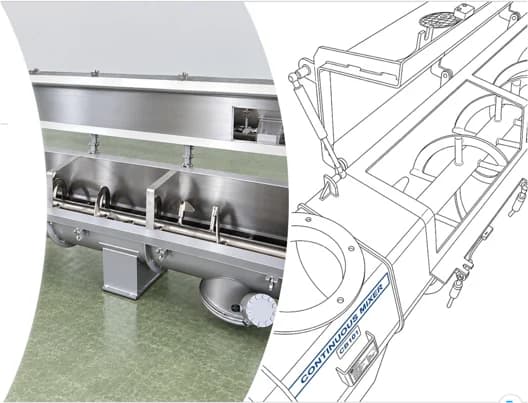
A ribbon blender is a horizontal U-trough with a double helical ribbon agitator. The outer ribbon moves material one way along the trough, the inner ribbon moves it back, and the counter-flow blends the batch. It suits dry powders and granules of broadly similar particle size, and it is the workhorse of food, pharma and chemical blending.
Paddle mixers use angled paddles instead of ribbons. They are gentler on friable product, handle wider particle-size differences without segregating, cope better with pastes and liquid addition, and discharge more completely. Where a blend contains both fine powder and coarse granule, a paddle is often the safer choice.
Minor ingredients decide whether the recipe holds. A trace additive at a fraction of a percent has to be weighed accurately, added at the right point in the cycle and given enough mixing time to distribute. PTP builds minor-ingredient dosing into the batching sequence with load cells and metering screws rather than leaving it to a hand scoop.
Grinding is chosen for the particle size the process needs, not for the finest the mill can reach. Pulverisers and impact mills reduce size; over-grinding costs power, creates dust and can damage heat-sensitive products. Zig-zag classifiers then separate ground material into fractions, returning oversize for another pass.
What follows the mixer matters as much as the mixer. A finished blend of mixed particle sizes will segregate in a high-velocity air line, in a badly designed hopper, or down a long chute. Dense phase conveying, correctly angled discharge and short drops keep the blend as it left the machine.
Scope
What we engineer and supply.
Selection
How the system gets specified.
- Ribbon or paddle
- Ribbon for dry powders and granules of similar particle size; paddle for friable product, wide size differences, liquid addition and complete discharge.
- Batch or continuous
- Batch mixing where recipes change and traceability is required; continuous blending where a single formulation runs at steady rate.
- Materials of construction
- Stainless steel 304 or 316 contact parts with polished internal finishes for food, dairy and pharma; mild steel for non-contact duties.
- Weighing
- Load-cell weigh hoppers, metering screw feeders and gain-in-weight or loss-in-weight dosing for major and minor ingredients.
- Grinding
- Pulverisers and impact mills sized to the target particle size, with zig-zag classification and oversize recirculation where a cut point is specified.
- Options
- Jacketed vessels for heating or cooling, spray bars for liquid addition, CIP connections, batch reporting and recipe management.
FAQ
Frequently asked questions.
Ribbon blender or paddle mixer?
A ribbon blender suits dry powders and granules of broadly similar size and is the cheaper, more common choice. A paddle mixer is gentler, handles wide particle-size differences and liquid addition better, and discharges more completely — worth the difference where segregation or residue is a problem.
How long should a batch be mixed?
Until the blend reaches the uniformity the specification requires, and no longer. Over-mixing wastes cycle time, generates fines and can de-mix a blend of unlike particles. Mixing time is set by sampling the actual formulation rather than by a rule of thumb.
How are minor ingredients dosed accurately?
With dedicated weighing rather than manual addition — load-cell hoppers and metering screws that dose trace additives to the recipe, added at a defined point in the mixing cycle and sequenced by the PLC so the batch record shows what went in.
Why does a good blend segregate after mixing?
Because handling after the mixer undoes it. High-velocity air conveying, long free-fall drops and funnel-flow hoppers all separate particles by size and density. Dense phase conveying, short drops and mass-flow discharge preserve the blend.
Where to next
Related pages.
Discuss your powder handling project.
Talk to an engineer.
Send the material, the throughput and the plant constraints. An engineer will come back with a route, not a brochure.