
Conveying
Dense phase pneumatic conveying
for abrasive, friable and blend-sensitive powders.
Where a powder is abrasive, breaks easily, or is a finished blend that must not separate, dense phase is usually the only conveying method that leaves it as it started.
In short
Dense phase pneumatic conveying moves powder through a pipeline as slow-moving slugs at low velocity and high pressure, rather than suspended in a fast air stream. Because the material travels slowly, abrasive powders cause far less pipe wear, friable granules arrive intact, and pre-mixed blends reach the destination without separating out.
In detail
How it works.
Dense phase conveying does not suspend the material. Compressed air or nitrogen is introduced in controlled pulses at the sending vessel, and the powder moves along the pipeline as a series of discrete slugs separated by air cushions. Conveying velocity is a fraction of dilute phase and the air-to-material ratio is much lower.
That low velocity is the whole point. Wear in a pneumatic line rises steeply with velocity, so an abrasive material such as titanium dioxide, silica or alumina removes far less pipe wall in dense phase. Friable products — coffee, pasta, extruded snacks, sugar crystals, catalyst pellets — arrive whole instead of as fines.
Blends behave differently too. In a fast air stream a pre-mixed powder with different particle sizes and densities will stratify, and what arrives at the packer is not what left the mixer. Slug flow keeps the blend together, which matters for spice mixes, premixes, dry beverage bases and pharmaceutical formulations.
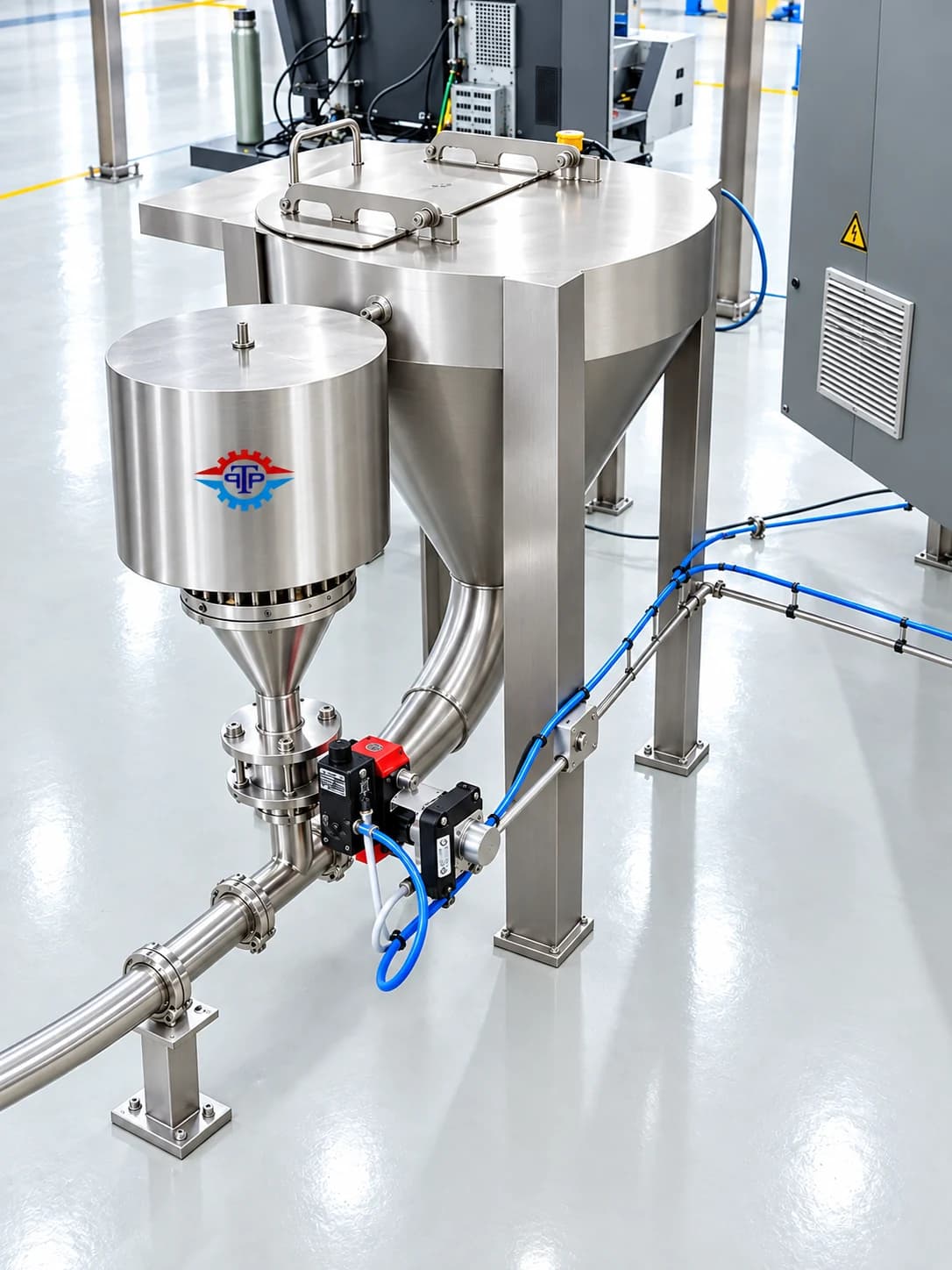
A dense phase system is built around a pressure vessel — a transporter or sender — that fills, seals, pressurises and discharges in a cycle. Because the duty is batch-wise rather than continuous, throughput is set by cycle time and vessel volume. Multiple vessels in parallel give near-continuous flow where the process needs it.
Compressed air is the running cost, so boosters and air-injection control matter. PTP integrates the transporters and injection technology with the material characterisation, the route, the receiving end and the controls, and commissions the line on site.
Scope
What we engineer and supply.
Selection
How the system gets specified.
- When to choose dense phase
- Abrasive, friable or blend-sensitive materials; long routes where velocity would otherwise be excessive; products that must not degrade.
- Conveying gas
- Compressed air as standard; nitrogen or inert gas where the product oxidises or the atmosphere must be inert.
- Flow regime
- Slug or plug flow at low velocity, controlled by staged air injection along the line.
- Duty
- Batch cycles from a pressure vessel; parallel vessels where the downstream process needs continuous feed.
- Materials of construction
- Stainless steel 304 or 316 for food, dairy and pharma duties; carbon steel where product contact permits.
- Conveying technology
- Dense phase conveying of bulk materials using compressed air, gas or nitrogen.
FAQ
Frequently asked questions.
When is dense phase conveying worth the extra cost?
When the material is abrasive enough to wear out a dilute phase line, fragile enough to break at high velocity, or a blend that would separate in transit. In those cases the saving on pipe replacement, product loss and rejected batches usually outweighs the higher capital cost.
Is dense phase conveying slower than dilute phase?
The material travels slower, but throughput is set by vessel size and cycle time, not velocity. A correctly sized dense phase system meets the same production rate; where the process needs uninterrupted flow, transporters are installed in parallel and sequenced.
Does dense phase conveying use less air?
It uses a much lower air-to-material ratio, but the air is at higher pressure. Compressed air is generally the dominant running cost, so injection along the line is controlled to keep slugs moving with the minimum gas needed.
Which materials are typically conveyed in dense phase?
Titanium dioxide, carbon black, silica, alumina and other abrasives; sugar, coffee, pasta, extruded snacks and other friable products; and finished blends such as spice mixes, premixes and pharmaceutical formulations.
Where to next
Related pages.
Discuss your powder handling project.
Talk to an engineer.
Send the material, the throughput and the plant constraints. An engineer will come back with a route, not a brochure.