
Conveying
Dilute phase pneumatic conveying
for free-flowing powders and granules.
Most powder transfer duties do not need dense phase. Where the material is free-flowing and tolerant of velocity, lean phase moves it with fewer moving parts, lower capital cost and simpler controls.
In short
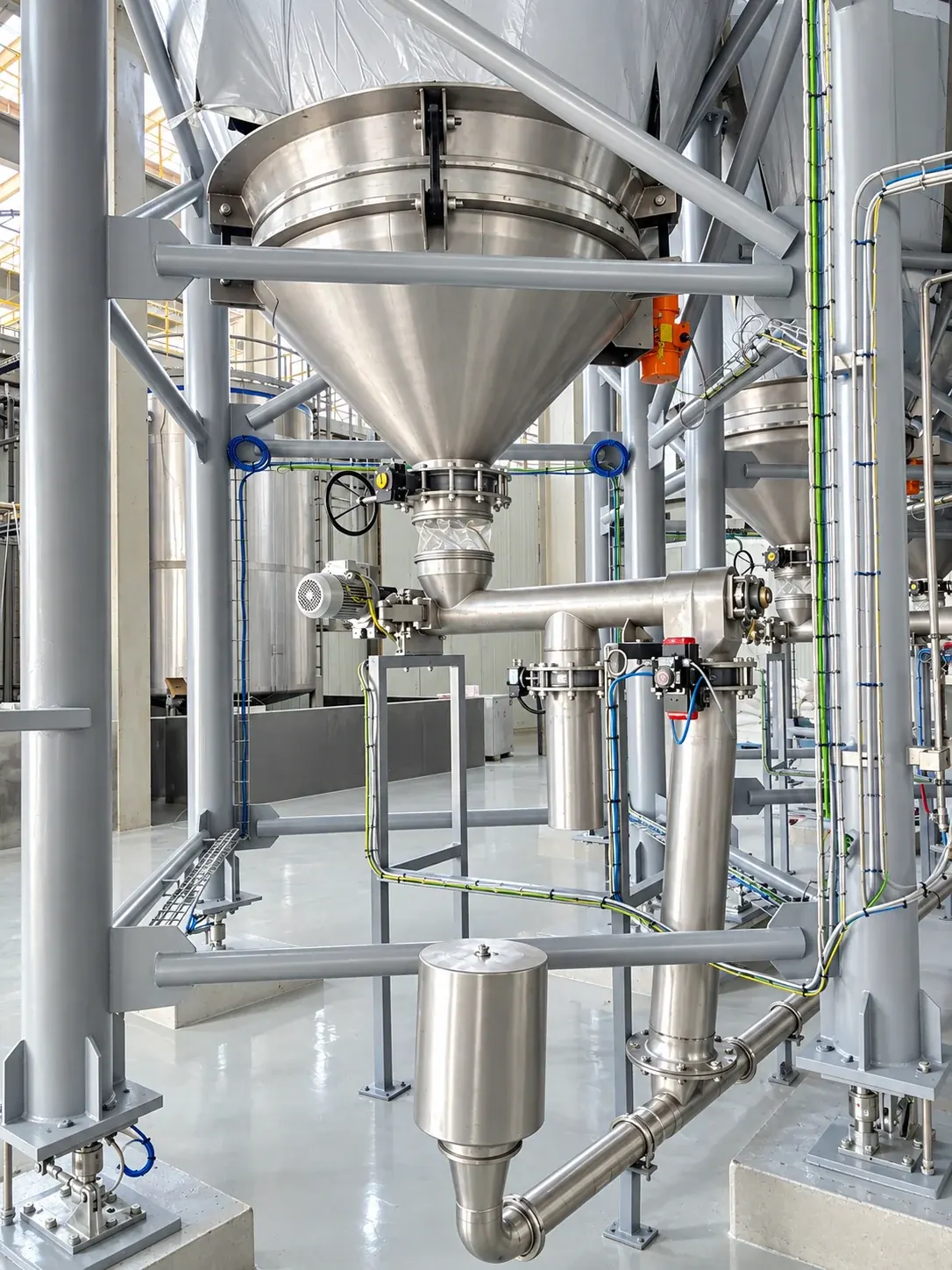
Dilute phase pneumatic conveying, also called lean phase, carries powder or granules fully suspended in a fast-moving air stream at relatively low pressure. The air-to-material ratio is high and velocity is high. It is the simplest and cheapest way to move free-flowing, non-abrasive materials through an enclosed pipeline.
In detail
How it works.
In dilute phase the air stream does all the work. Velocity is kept above the saltation point — the speed below which particles drop out of suspension and settle on the pipe floor — so material stays airborne from pick-up to receiver. That threshold, not the throughput, sets the minimum conveying velocity.
The system is an air mover, a feed device, a pipeline and a separator. On the pressure side a rotary airlock valve meters material into the moving air. On the vacuum side a pick-up wand, hopper or bulk bag discharge point is opened to the line. At the receiving end a cyclone or filter receiver drops the material out and vents clean air.
Vacuum systems are common in food, dairy and pharma areas because any leak in the line draws inward. Several pick-up points can feed one destination — several bag tip stations feeding one mixer, for example — with no valve needed at each source. Distance and throughput are limited by the vacuum available.
Pressure systems reach further and can serve several destinations from one source, routed by diverter valves. They need a rotary airlock at the feed point to admit material against pressure, and a vent filter at each receiving vessel.
The design risk in lean phase is degradation and wear, not capacity. At high velocity soft granules break up and abrasive powders cut into bends. Where either is a concern, PTP either specifies long-radius or wear-resistant bends, or moves the duty to dense phase.
Scope
What we engineer and supply.
Selection
How the system gets specified.
- When to choose lean phase
- Free-flowing, non-abrasive, degradation-tolerant materials over short to medium runs where capital cost matters.
- Pressure or vacuum
- Vacuum for several pick-up points to one destination and inward-leaking containment; pressure for one source to several destinations and longer routes.
- Air movers
- Roots-type positive displacement blowers, side channel or regenerative blowers and vacuum pumps, sized to the duty.
- Separation
- Cyclone receivers where fines loading allows; filter receivers with reverse-jet cleaning where emission or product recovery matters.
- Materials of construction
- Stainless steel 304 or 316 for food, dairy and pharma; mild steel or aluminium elsewhere.
- Options
- Multi-point pick-up, multi-destination diverting, in-line magnets and metal detection, filter differential-pressure monitoring.
FAQ
Frequently asked questions.
What is the difference between lean phase and dilute phase conveying?
None — they are two names for the same thing. Lean phase is the more common term in India and Europe, dilute phase in North American literature. Both describe material carried fully suspended in a high-velocity air stream.
Why does dilute phase conveying need a minimum velocity?
Below the saltation velocity, particles fall out of suspension and settle along the bottom of the pipe. The layer builds until the line chokes. Systems are designed with a margin above saltation for the heaviest material the line will carry.
Does dilute phase conveying damage the product?
It can. At conveying velocity, soft granules chip and pellets streak against bends. If the product is friable or the finish matters, the options are long-radius bends, wear-resistant elbows, reduced velocity, or moving the duty to dense phase.
Can one vacuum system serve several pick-up points?
Yes, and that is its main advantage. Several bag tip stations, bulk bag unloaders or drum pick-up wands can feed a single receiver, with only the point in use opened to the line. No airlock is needed at each source.
Where to next
Related pages.
Discuss your powder handling project.
Talk to an engineer.
Send the material, the throughput and the plant constraints. An engineer will come back with a route, not a brochure.