
SOLUTIONS — CONVEYING
Pneumatic Conveying Systems
Lean Phase & Dense Phase Systems—Custom-Engineered to Your Material Characteristics
At Paul Techno Process (PTP), we engineer high-efficiency pneumatic conveying lines specifically tailored for food, dairy, pharmaceutical, paint, chemical, and plastics manufacturing facilities. Instead of forcing standard off-the-shelf catalog equipment onto your line, every aspect—including the conveying route, line velocity, transfer regime, and air-mover technology—is precisely calculated and sized around your specific bulk material properties.
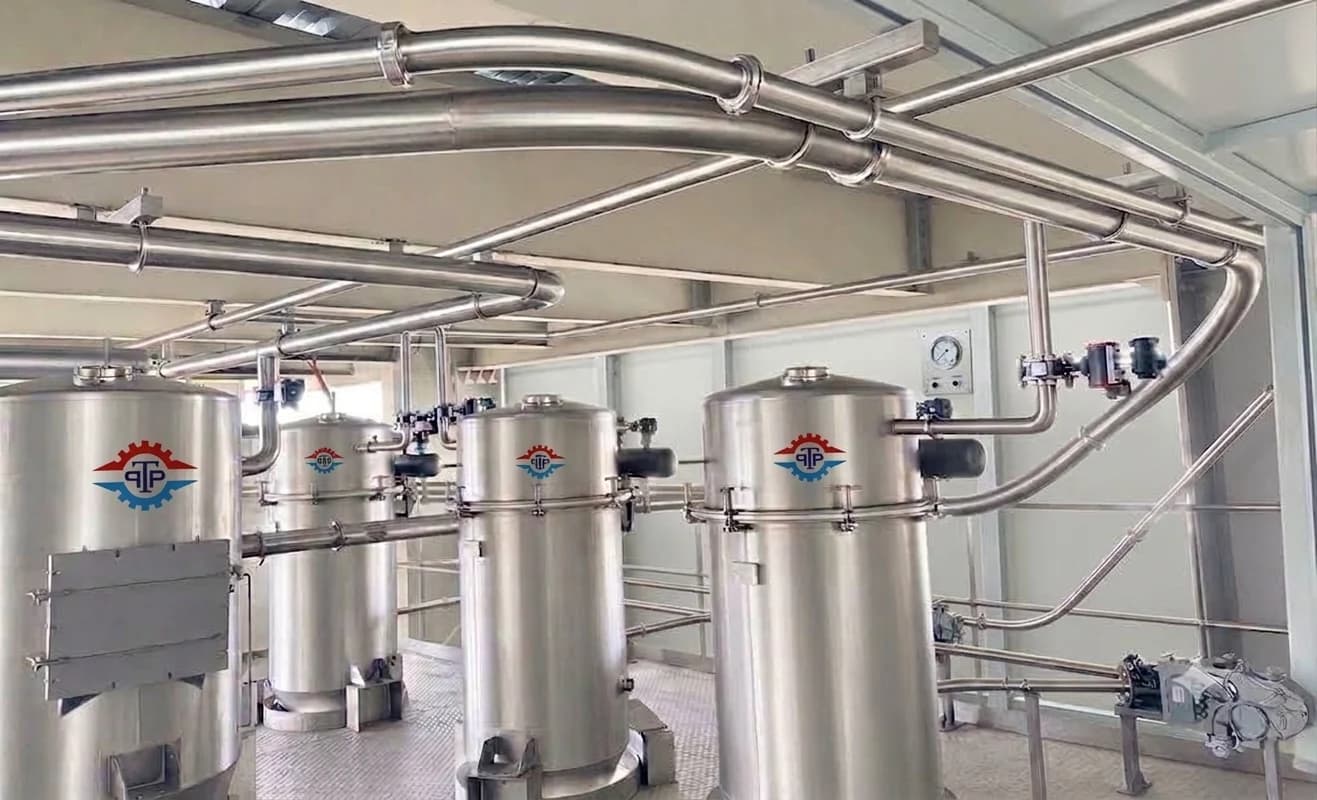
In short
How Pneumatic Conveying Works: A pneumatic conveying system transfers powders and bulk granules through a fully enclosed pipeline using air or an inert gas stream. Material is transferred either suspended in a high-velocity air stream (dilute/lean phase) or pushed along as slow-moving plugs at low velocity (dense phase). Because the entire transfer path is completely sealed, dust escape and external product contamination are prevented entirely.
In detail
How it works.
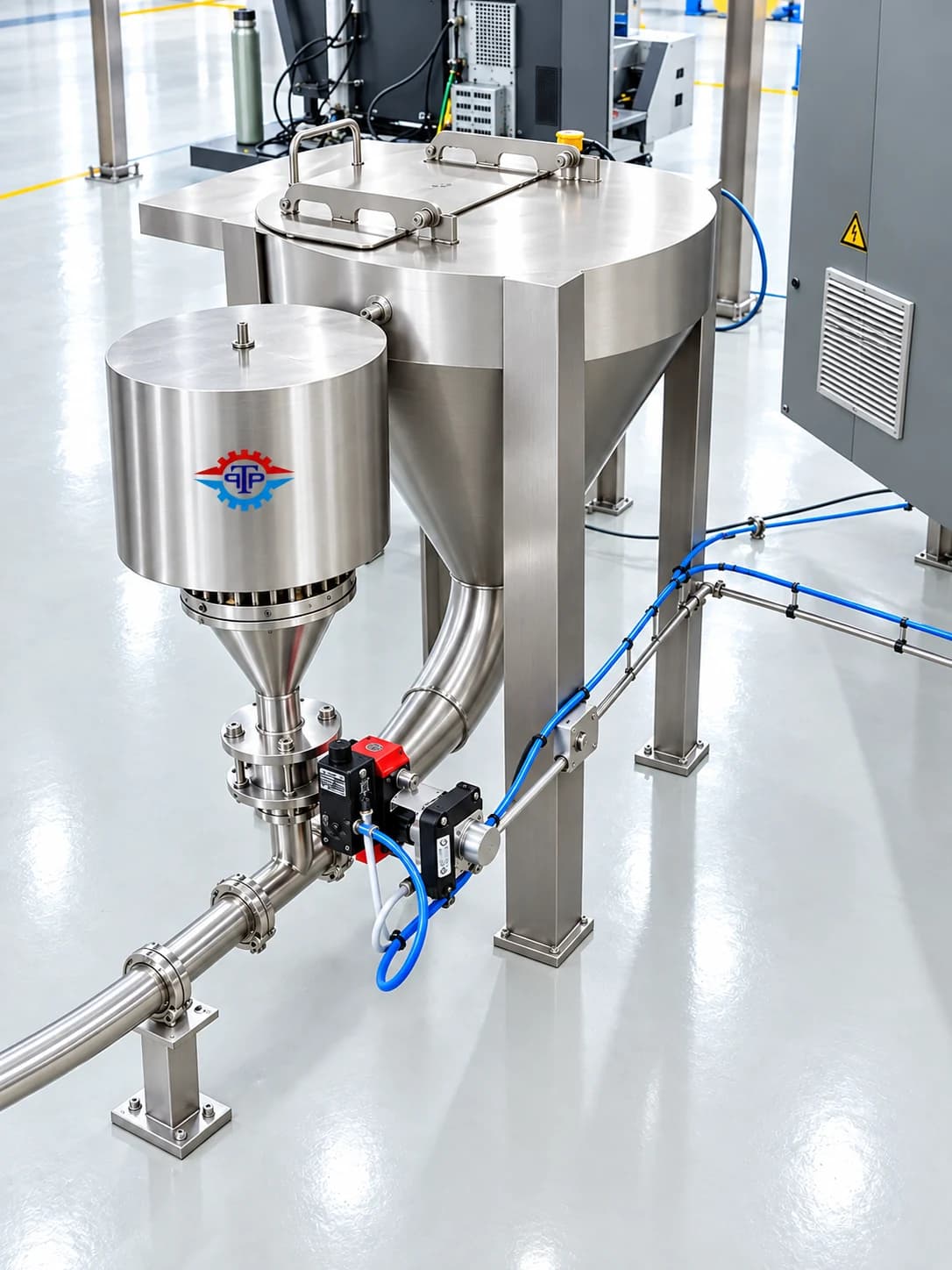
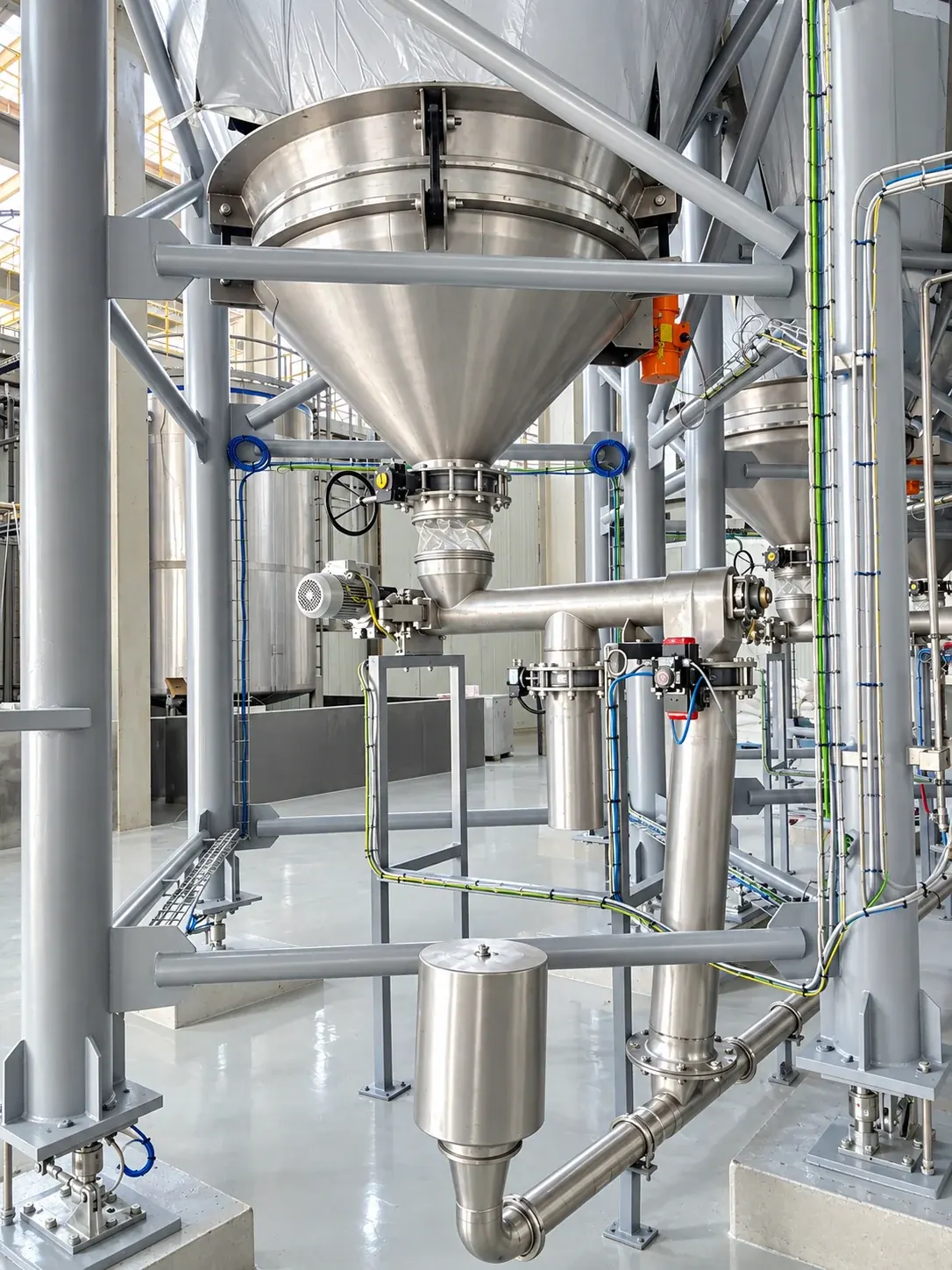
A pneumatic conveying system is an air mover, a feed point, a pipeline and a receiver. Air from a blower, fan or compressor carries the material along the pipe; at the far end a cyclone receiver or filter receiver separates the material from the air and drops it into the next stage. Everything in between is enclosed.
The choice that matters most is phase. In dilute phase the material is fully suspended in a fast-moving air stream at relatively low pressure. In dense phase it moves as slugs at low velocity and higher pressure. Dilute phase suits free-flowing, non-abrasive materials over shorter runs; dense phase suits abrasive, friable or blend-sensitive materials.
Systems run on positive pressure or vacuum. Positive pressure pushes from a single pick-up point to one or several destinations and handles longer distances. Vacuum pulls from several pick-up points to one destination, keeps any leak inward, and is often the safer choice where the powder is toxic or the area must stay clean.
Sizing is not a formula applied to a nameplate. Bulk density, particle size distribution, moisture, abrasiveness, friability and how the powder behaves when aerated all change the answer. PTP characterises the material first, then fixes conveying velocity, line size, air volume and pressure drop around it.
Line components decide whether the design survives contact with a production floor. Rotary airlock valves feed material into pressure, diverter valves route it, long-radius bends limit wear and degradation, and filter or cyclone receivers control what leaves the system. PTP specifies these as part of the design rather than leaving them to the installer.
Scope
What we engineer and supply.
Selection
How the system gets specified.
- Phase selection
- Dilute phase for free-flowing, non-abrasive powders; dense phase where abrasion, breakage or blend separation matters.
- Pressure or vacuum
- Pressure for one source to many destinations and longer runs; vacuum for many sources to one destination and inward-leaking containment.
- Materials of construction
- Stainless steel 304 or 316 for food, dairy and pharma; mild steel or aluminium where product contact allows.
- Line components
- Rotary airlocks, diverter valves, magnets, metal detectors and sight glasses integrated into the line.
- Options
- Nitrogen or inert gas conveying, explosion venting and isolation, PLC sequencing, remote diagnostics.
The range
Conveying Methods Built Around Your Material
Every system is precision-engineered to match your powder’s characteristics and operational requirements.
FAQ
Frequently asked questions.
What is the difference between dilute phase and dense phase conveying?
Dilute phase suspends material in a fast air stream at low pressure; dense phase pushes it along as slow slugs at higher pressure. Dilute phase equipment is simpler and cheaper. Dense phase is chosen when the powder is abrasive, friable, or a blend that would separate at high velocity.
Should the system run on positive pressure or vacuum?
Positive pressure suits one pick-up point feeding several destinations and covers longer distances. Vacuum suits several pick-up points feeding one destination, and any leak draws inward rather than releasing dust — which is why it is common in food, dairy and pharma areas.
How far can powder be conveyed pneumatically?
Distance depends on the material, the phase, the pressure available and how much degradation is acceptable, so there is no single figure. PTP fixes the conveying distance during material characterisation and sizes the air mover and line diameter around it.
Can a pneumatic conveying system handle fragile or abrasive materials?
Yes, but usually in dense phase. At low velocity, abrasive powders remove far less pipe wall and friable granules arrive intact. Long-radius or wear-resistant bends are specified where the route forces direction changes.
Where to next
Related pages.
Discuss your powder handling project.
Talk to an engineer.
Send the material, the throughput and the plant constraints. An engineer will come back with a route, not a brochure.