
SOLUTIONS — STORAGE
Bulk Storage Silos
Rigid Stainless, Aluminium, Flexible, and Fiberglass Silos—Engineered Around Your Discharge Strategy
At Paul Techno Process (PTP), we engineer and supply comprehensive bulk storage silo systems built to maintain raw material integrity and ensure smooth, controlled discharge into your process line. While selecting the right shell material is vital for durability and hygiene, the discharge design matters most—ensuring reliable material flow without rat-holing, bridging, or segregation.
In short
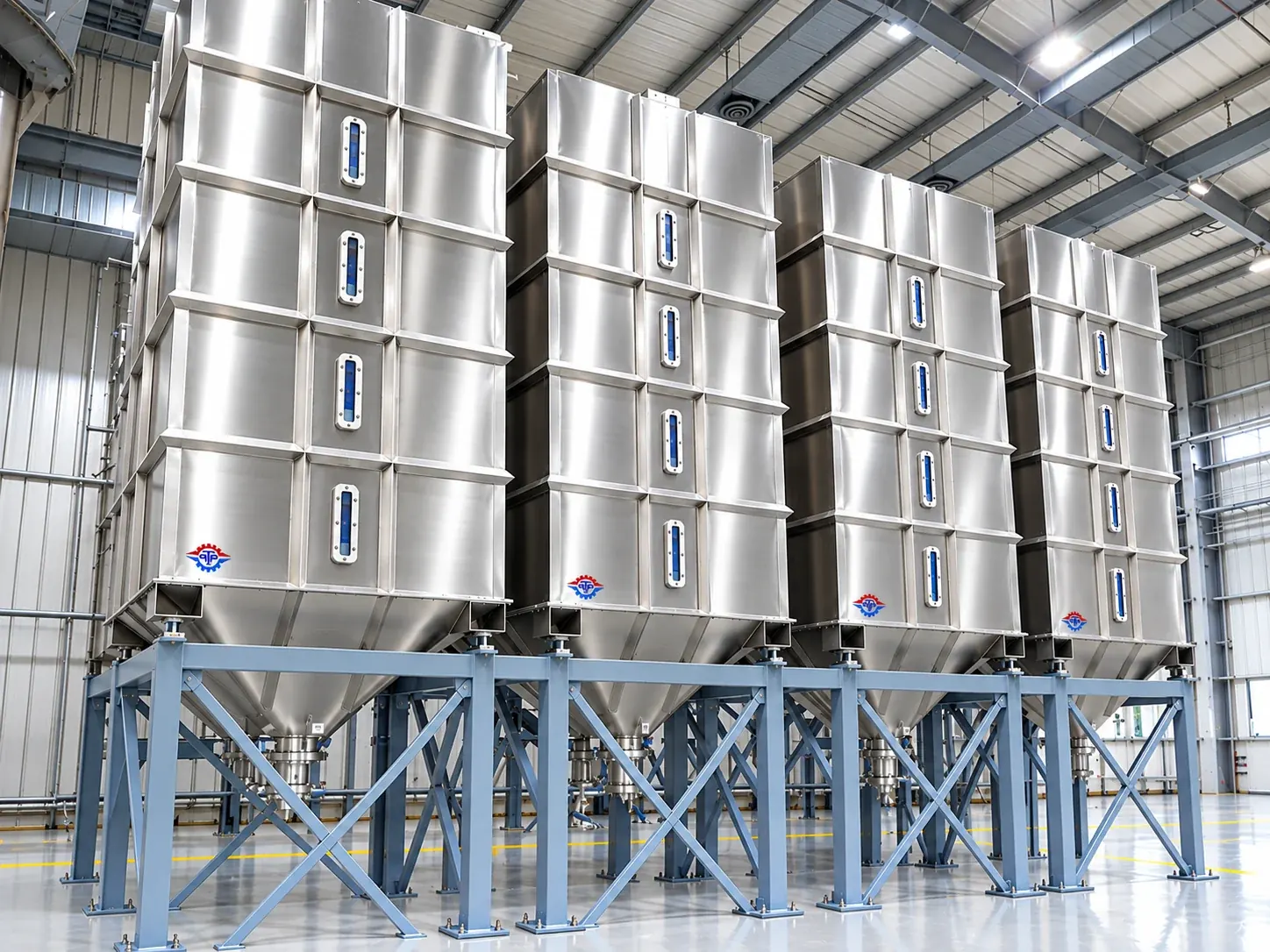
How Storage Silos Work: A storage silo safely holds bulk powders or granules between raw material delivery and production, feeding your downstream processes at a controlled rate. Rigid Silos (Stainless Steel & Aluminium): Ideal for large-capacity outdoor or indoor bulk storage. Flexible & Fiberglass Silos: Mounted on bolted steel frames indoors, offering a cost-effective installation solution for small to medium storage volumes
In detail
How it works.
A silo is judged on how reliably it empties, not on how much it holds. Cohesive powders bridge across the outlet or rathole down the centre, leaving material stagnant against the wall. The cure is geometry — hopper half-angle and wall finish chosen against the powder's measured flow properties — with discharge aids as backup rather than as the primary design.
Mass flow moves the whole contents together, first in first out, and suits hygroscopic, segregating and shelf-life-limited products. Funnel flow accepts a central channel and is cheaper and shorter, which is acceptable for free-flowing, non-degrading materials. Choosing the wrong one is expensive to correct once the silo is up.
Rigid silos are fabricated in stainless steel or aluminium, mounted outdoors on legs or a skirt, and filled by tanker blow-in or a pneumatic conveying line. They carry a vent filter at the top to release conveying air cleanly, pressure and vacuum relief, level instrumentation, and a discharge arrangement sized to the downstream duty.
Flexible and fiberglass silos sit inside the building on a bolted steel frame. The fabric or fiberglass body doubles as the filter, venting conveying air through the wall, so no separate vent filter is needed. They erect fast, cost less than a fabricated shell at smaller volumes, and suit plants that cannot take an outdoor structure.
Around either type, PTP supplies the parts that make it work: tanker blow-in connections, level probes and load cells, filter and vent arrangements, bin activators, fluidising pads or aeration cones, rotary valves, and the screw or pneumatic take-off that feeds the process.
Scope
What we engineer and supply.
Selection
How the system gets specified.
- Rigid or flexible
- Rigid stainless or aluminium for outdoor bulk storage and larger volumes; flexible or fiberglass for indoor installation, faster erection and smaller volumes.
- Flow pattern
- Mass flow for cohesive, hygroscopic, segregating or shelf-life-limited powders; funnel flow for free-flowing materials where headroom is short.
- Materials of construction
- Stainless steel 304 or 316 for food, dairy and pharma; aluminium and mild steel where product contact permits.
- Filling
- Tanker blow-in, pneumatic conveying line, bulk bag discharge or screw feed, with vent filtration matched to the fill rate.
- Discharge aids
- Bin activators, vibrating cones, fluidising pads, aeration and air cannons, specified against measured flow properties.
- Instrumentation
- Level probes, radar level, load cells for inventory, high and low alarms, and interlocks to the fill line.
FAQ
Frequently asked questions.
What size and type of silo does a plant need?
It follows from delivery size, consumption rate and the buffer the plant wants between deliveries — then from the powder itself. A cohesive powder needs a steeper, smoother hopper than a free-flowing granule for the same volume, so the flow properties set the geometry.
Why does powder bridge in a silo?
Because the arch of material over the outlet is strong enough to support itself. That happens when the outlet is too small or the hopper walls too shallow for the powder's cohesive strength. Enlarging the outlet, steepening and polishing the hopper, or fitting a bin activator are the usual fixes.
Flexible silo or rigid steel silo?
Flexible and fiberglass silos install inside an existing building, erect quickly on a bolted frame, and vent through their own wall so no separate filter is needed. Rigid stainless or aluminium silos suit outdoor installation, larger volumes and duties needing a washdown or pressure-rated shell.
Does PTP install silos in India?
Yes. PTP is based in Electronics City, Bengaluru, and designs, supplies, installs and commissions silos and their discharge equipment across India, including fill lines, level instrumentation and the take-off to the process.
Where to next
Related pages.
Discuss your powder handling project.
Talk to an engineer.
Send the material, the throughput and the plant constraints. An engineer will come back with a route, not a brochure.