
Components
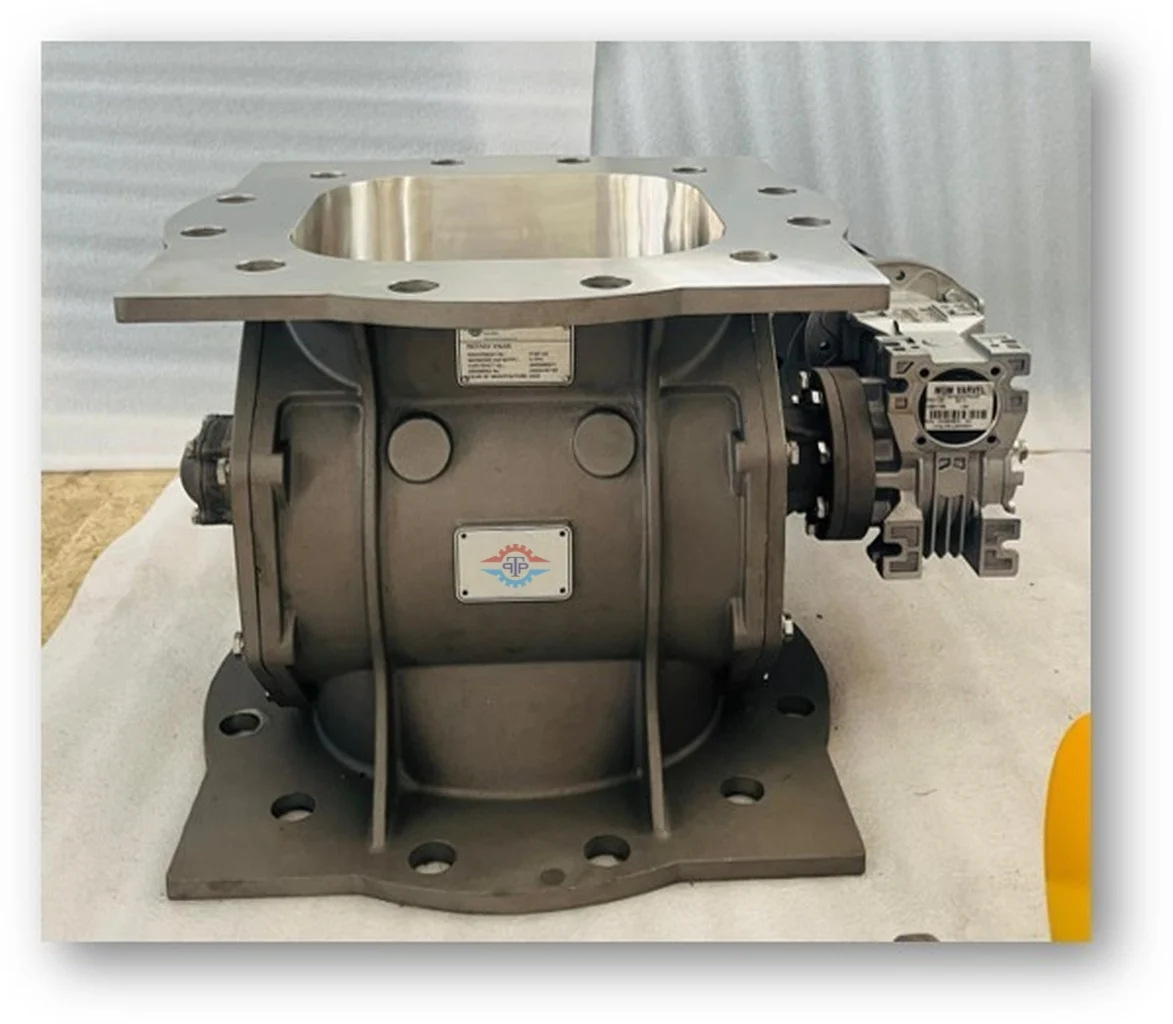
Rotary valves and airlockscast and fabricated, for pressure and vacuum lines.
The workhorse of a powder line. A rotary valve feeds product into a pressurised conveying line at a controlled rate while holding the pressure seal that keeps the air where it belongs.
In short
A rotary valve, also called a rotary airlock, meters powder or granules from a hopper into a conveying line while holding the pressure difference between the two. A rotor with fixed vanes turns inside a machined housing, so each pocket fills at the inlet and empties at the outlet without opening a straight path for air.
In detail
How it works.
Two jobs are being done at once, and they pull against each other. The valve has to pass product at a steady rate, which wants generous pockets and clearance. It also has to hold a pressure seal, which wants tight tolerances between the rotor tips and the bore. Get the balance wrong and you either starve the line or leak conveying air backwards up into the hopper, where it fluidises the powder and stops it feeding. Most rotary valve complaints on a plant trace back to that single trade-off being set for the wrong product.
Product behaviour decides the rotor. A free-flowing granule fills and empties a deep closed pocket cleanly. A friable granule shears at the rotor tip and arrives at the packer as dust, so the pocket is made shallow and the tips are bevelled. An abrasive mineral wears the bore oval over time, so the vane tips are made adjustable or replaceable and the housing is hardened. A sticky or hygroscopic powder builds up in the pocket and needs a rotor that can be withdrawn and washed without disturbing the drive.
Blow-through valves sit differently in the line. Instead of dropping product down through the rotor into a separate pickup point, the conveying air passes straight through the rotor pocket and takes the charge with it. That clears the pocket properly and shortens the layout, which is why it is common under a bulk bag unloader or a bag dump station where headroom is short.
PTP supplies rotary valves on their own, not only as part of a system. That covers a replacement for a worn valve on an existing line, a second valve for a new take-off point, or a full set for a plant PTP is building. Where the valve is going into a line PTP did not engineer, send the product name, the pressure the valve has to hold and the flange arrangement it has to match, and the selection can be done from that.
Scope
Types and options.
Selection
How it gets specified.
- Valve type
- Drop-through airlock where product falls into a separate pickup point; blow-through where the conveying air passes through the rotor pocket and clears it in one move.
- Body and rotor material
- Cast iron for general industrial duty; cast or fabricated stainless steel where the powder is food, dairy or pharma contact and the line is washed down.
- Rotor form
- Closed vanes for the tightest seal, shallow or scalloped pockets where the granule is friable, adjustable tip strips where the powder is abrasive.
- Sealing arrangement
- Shaft seals and end-cover design chosen against the pressure differential across the valve and whether the powder is fine enough to migrate along the shaft.
- Cleaning access
- Quick-release covers and withdrawable rotors where the line runs multiple products and has to be stripped and cleaned between them.
FAQ
Frequently asked questions.
What does a rotary airlock valve actually do?
It moves powder from one pressure to another without letting the air follow. The rotor pockets fill under gravity at the inlet and discharge at the outlet, and because a vane is always in contact with the bore there is never an open path between the two. That is what lets a hopper at atmospheric pressure feed a pressurised conveying line.
What is the difference between a drop-through and a blow-through rotary valve?
A drop-through valve discharges into a separate pickup point below it, so the conveying line is a distinct piece of pipework. A blow-through valve has the conveying line running through the valve body itself, so the air sweeps each pocket as it comes round. Blow-through clears sticky product better and saves headroom; drop-through is simpler to maintain.
Can PTP supply a rotary valve for a line it did not build?
Yes. Components are supplied individually as a retrofit or a spare. What is needed is the product being handled, the pressure or vacuum the valve has to hold, the flange or inlet arrangement it has to match, and the drive orientation. The selection is made from that, and PTP will say plainly if a like-for-like replacement is the wrong answer.
Where to next
Related pages.
Discuss your powder handling project.
Talk to an engineer.
Send the material, the throughput and the plant constraints. An engineer will come back with a route, not a brochure.