
Turnkey systems
Powder handling systemsintake to dispatch, engineered as one line.
PTP engineers the whole route rather than a machine at a time. Intake, storage, transfer, sieving, batching, mixing and dispatch designed as one system, with one contract and one party accountable for the throughput.
In short
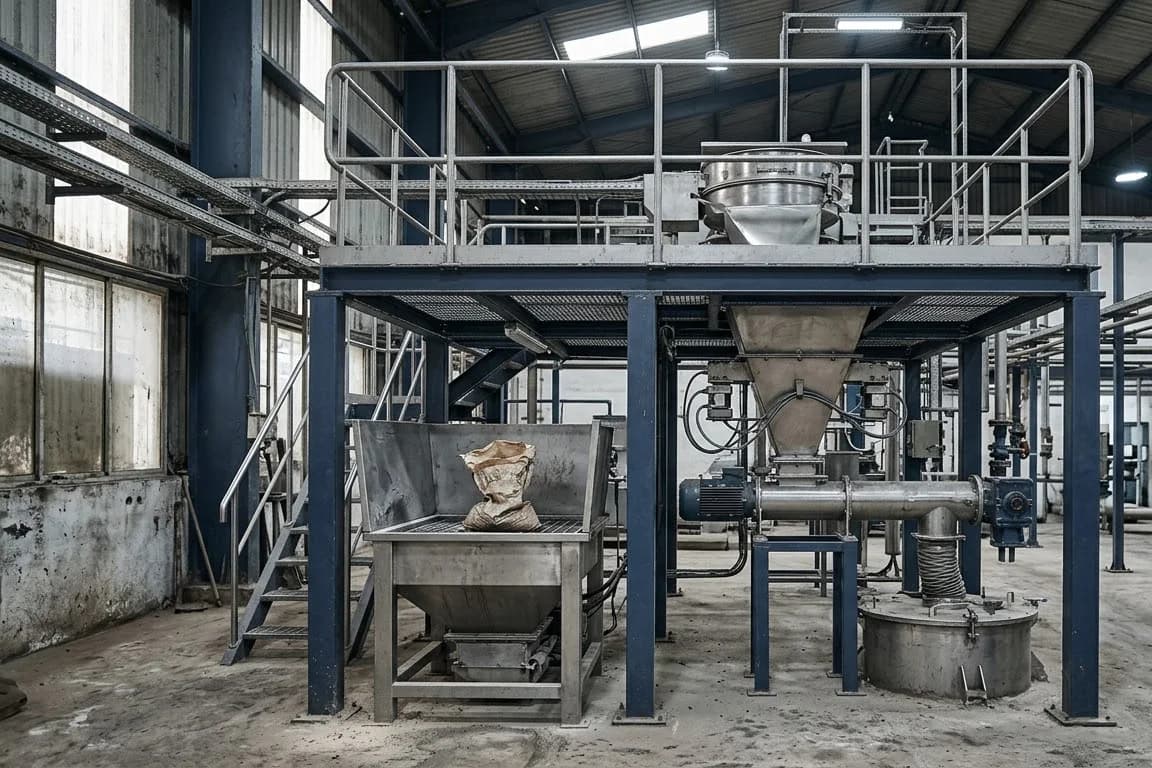
A powder handling system is the complete route a dry material takes through a plant: intake from bags, bulk bags or tankers, storage in silos or bins, transfer by pneumatic or mechanical conveying, processing steps such as sieving, mixing and dosing, and dispatch into bags, bulk bags or tankers.
In detail
How it works.
Powder plants rarely fail at a machine. They fail at the joins — a conveying line that outruns the sieve behind it, a mixer that empties faster than the packer can take, a silo discharge sized for a free-flowing powder that turns out to be hygroscopic. Designing stage by stage from separate suppliers is what creates those joins.
The route starts at intake. Bag dump stations for sacks, bulk bag unloaders for FIBCs, tanker blow-in connections for bulk delivery — each with dust extraction, screening and metal detection at the point where foreign matter is most likely to enter. What gets caught here never has to be recalled later.
Between intake and process sit storage and transfer. Rigid or flexible silos, hoppers and mobile bins hold the material; pneumatic lines, screw conveyors, flexible screws and vibratory feeders move it. The choice at each leg follows the powder's abrasiveness, friability and flow behaviour, not what happens to be in the plant already.
The process stages — sieving, grinding, classifying, batching, mixing, minor-ingredient dosing — are where recipe accuracy and blend integrity are won or lost. Weighing, sequencing and the conveying method that follows the mixer have to be chosen together, because a fast air stream will undo a good blend in twenty metres of pipe.
Dispatch closes the line: small-bag and big-bag filling, bulk tanker and ISO container loading, with dust collection and product recovery at each point. PTP takes the whole route through design, supply, installation and commissioning, and stays on it afterwards for spares and support.
Scope
What we engineer and supply.
Selection
How the system gets specified.
- Scope
- Concept, process design, equipment supply, installation, commissioning and operator handover under one contract.
- Intake options
- Sack tipping, bulk bag discharge, tanker blow-in and drum or bin transfer, each with capture at the dust source.
- Transfer options
- Lean and dense phase pneumatic, U-trough and tubular screws, flexible screws and vibratory tube feeders.
- Product protection
- Sieving, magnetic separation, metal detection and dehumidification specified at the points where risk enters.
- Materials of construction
- Stainless steel 304 or 316 on contact parts for food, dairy and pharma; mild steel and aluminium where duty permits.
- Controls
- PLC and HMI sequencing, recipe management, weighing integration and remote diagnostics.
FAQ
Frequently asked questions.
What does a complete powder handling system include?
Intake, storage, transfer, processing and dispatch, plus the dust collection, product protection and controls that run across all of them. In practice: bag or bulk bag intake, silos, conveying, sieving, batching and mixing, packing or tanker loading, and a PLC tying them together.
Why buy the system from one supplier rather than machine by machine?
Because throughput is set by the joins, not the machines. A single design authority sizes each stage against the one before and after it, and one party is accountable when the line does not make rate. Buying machine by machine moves that risk onto the plant.
How is the right conveying method chosen for a powder?
By characterising the material first — bulk density, particle size distribution, moisture, abrasiveness, friability and flow behaviour — then matching it to distance, throughput and hygiene requirements. Abrasive or fragile powders point to dense phase; short lifted runs point to a flexible screw.
Can PTP work with equipment already installed?
Yes. Retrofits, capacity upgrades and integration with existing machines are a normal part of the work, alongside spares supply and annual maintenance support.
Where to next
Related pages.
Discuss your powder handling project.
Talk to an engineer.
Send the material, the throughput and the plant constraints. An engineer will come back with a route, not a brochure.