
Intake & dispatch
Packaging systems
bulk bag filling, bag dump stations and bulk bag unloading.
Intake and dispatch are where powder meets people, and where most of a plant's dust and manual handling sits. PTP engineers both ends — bag dump stations, bulk bag unloaders and bulk bag fillers — with capture and weighing designed in.
In short
Packaging and bagging systems handle the two ends of a powder line: intake, where sacks and bulk bags are emptied into the process, and dispatch, where finished product is filled into small bags, bulk bags, tankers or containers. Both are dust-generating points and both are usually weighed.
In detail
How it works.
A bag dump station is a hopper with a grid, an operator platform and dust extraction across the tipping face. Done properly, the extraction pulls air away from the operator's breathing zone rather than across it, a screen catches string and sack fragments, and a compactor takes the empty sacks without a second dust release.
Bulk bag unloaders take FIBCs. A frame lifts the bag, an untying enclosure contains the spout, and massage paddles or a vibrating tray persuade a settled powder to discharge. Where the material bridges, the discharge aids matter more than the frame; where it flows freely, the seal at the spout matters more.
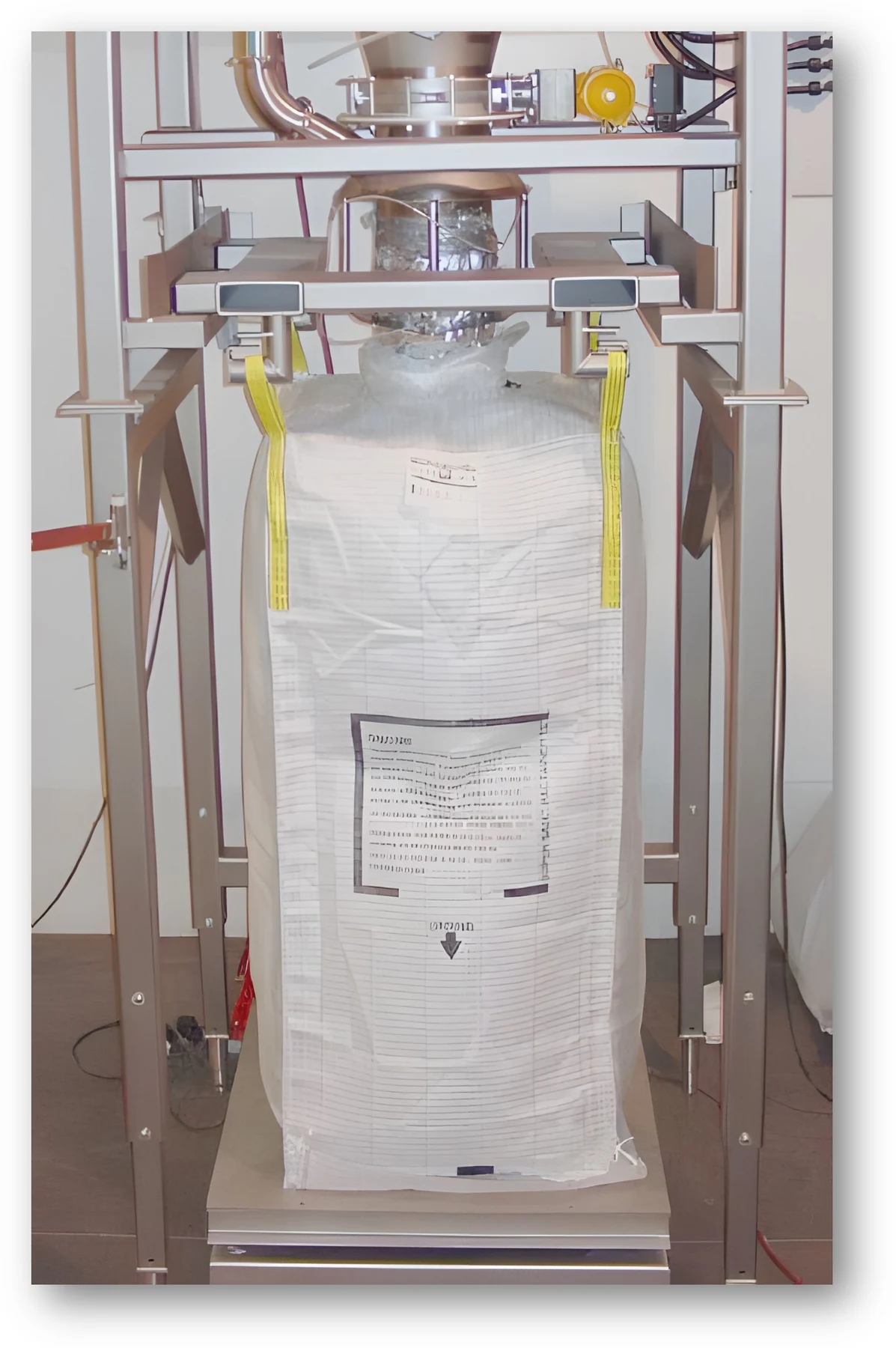
Bulk bag fillers reverse the sequence. The empty bag is hung on inflatable spout clamps, filled through a dust-tight head with displaced air taken back through the fill spout, densified as it fills so the bag stands square on the pallet, and weighed on a platform underneath. A bag that will not stand on a pallet is a filling problem, not a bag problem.
Small-bag filling at speed brings its own equipment — open-mouth and valve bag fillers, weighers, sealers and check weighing — and the same principle applies: capture the dust at the fill head, not in the room afterwards.
At the far end, tanker and ISO container loading closes the line, with blow-in connections, loading bellows, filters and the interlocks that stop a fill before it overfills. PTP supplies these alongside the blowers, compressors and dust collectors that serve them.
Scope
What we engineer and supply.
Selection
How the system gets specified.
- Intake equipment
- Bag dump stations, bulk bag unloaders and tanker blow-in connections, each with capture at the dust source.
- Dispatch equipment
- Bulk bag fillers, small-bag and open-mouth fillers, and bulk tanker or ISO container loading.
- Weighing
- Platform load cells with gain-in-weight or loss-in-weight control, coarse and dribble feed, and check weighing on dispatch.
- Dust control
- Local extraction at each tip and fill point, ducted to an individual or centralised collector, with product recovery where the dust is saleable.
- Product protection
- Screening grids, in-line magnets and metal detection at intake, where foreign matter is most likely to enter.
- Materials of construction
- Stainless steel 304 or 316 contact parts for food, dairy and pharma; mild steel frames and coated finishes elsewhere.
FAQ
Frequently asked questions.
What does a bulk bag filler need to produce a stable bag?
Densification while filling. Vibration or settling as the bag fills packs the powder down so the bag stands square on the pallet and stacks safely. Without it the bag slumps, the pallet is unstable, and the stated fill weight sits in an unpredictable shape.
How is dust controlled at a bag dump station?
By capturing at the tipping face. Extraction is designed to draw air away from the operator rather than across them, the hood is close enough to hold capture velocity, a grid screens out foreign matter, and empty sacks go straight into a compactor instead of being shaken out.
What if powder will not discharge from a bulk bag?
The bag has usually consolidated in storage. Massage paddles, a vibrating discharge tray or a bag agitator break the arch. Where the powder is persistently cohesive, the untying enclosure and discharge geometry are designed for it rather than fitted afterwards.
Can filling stations be weighed and recorded?
Yes. Load cells under the fill platform, gain-in-weight or loss-in-weight control and a coarse-then-dribble fill sequence give a repeatable target weight, and the PLC records each fill against the batch.
Discuss your powder handling project.
Talk to an engineer.
Send the material, the throughput and the plant constraints. An engineer will come back with a route, not a brochure.