
Bulk transport
Dry bulk tankers
bulkers for food, petrochemical and plastics.
PTP designs dry bulk tankers for food and non-food products, and supplies the loading and unloading equipment at both ends. Design and engineering are PTP's; fabrication is carried out by a third-party fabricator to that design.
In short
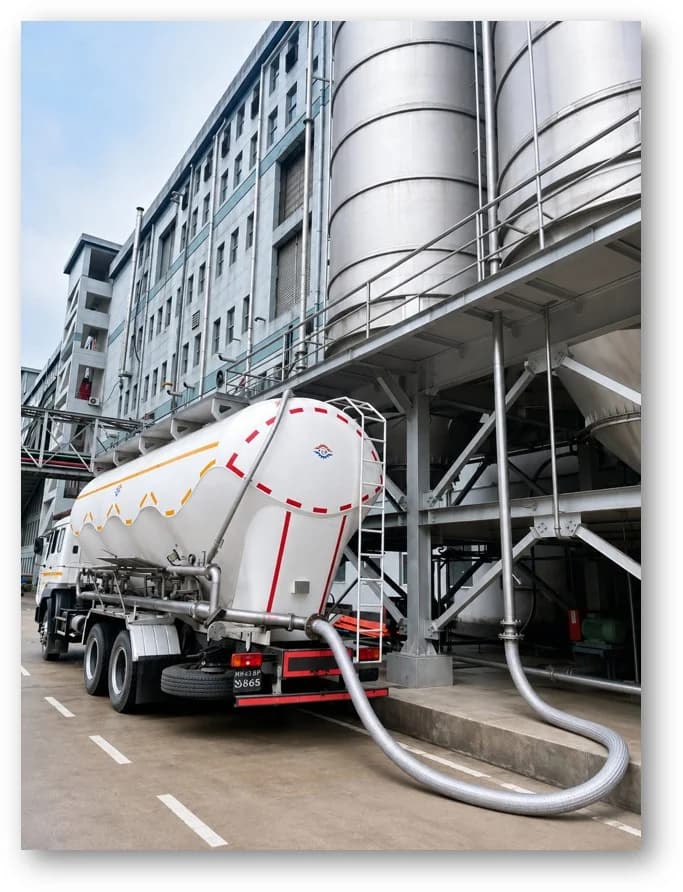
A dry bulk tanker, or bulker, carries powder or granules in sealed pressure compartments and discharges them pneumatically. Compressed air fluidises the load through aeration pads in the cone bottoms and blows it out through a discharge line into a silo, so the material is never exposed between plants.
In detail
How it works.
Bulk transport removes packaging from the equation. Where a plant takes several tonnes of a single material regularly, moving it in a tanker instead of sacks or bulk bags cuts packaging cost, manual handling, dust exposure at intake and the waste stream that follows. The trade is that both ends of the journey need equipment.
The tanker itself is a set of sealed compartments with cone bottoms, each with aeration pads in the cone. To discharge, the vessel is pressurised, air is fed into the pads to fluidise the powder above them, and the material flows to the outlet and up the blow line to the receiving silo. Compartments discharge in sequence.
Food duty changes the specification. Stainless steel tanks, product-contact finishes that clean properly, filtered discharge air, dedicated hoses and documented cleaning between loads are what separate a food bulker from a general-purpose tanker. PTP designs food and non-food tankers to different standards for that reason.
The receiving end is where most problems appear. A silo taking a tanker blow-in needs a vent filter sized for the fill air rate, pressure and vacuum relief, level instrumentation with a high-level interlock, and a fill connection that cannot be coupled to the wrong silo. PTP supplies the blow-in lines, filters and interlocks alongside the tanker design.
Around both ends sit the accessories: blowers and compressors for discharge air, dust collectors on the receiving vent, hoses, couplings and filters. These are supplied rather than manufactured, and specified against the material and the fill rate the plant actually runs.
Scope
What we engineer and supply.
Selection
How the system gets specified.
- PTP's role
- Design and engineering of the tanker by PTP; fabrication carried out by a third-party fabricator to that design. Blowers, compressors and accessories are supplied.
- Products carried
- Food powders and granules, petrochemical products and plastics raw materials, with different specifications for food and non-food duty.
- Discharge
- Pneumatic discharge from pressurised compartments through aeration pads in the cone bottoms, compartment by compartment.
- Materials of construction
- Stainless steel tanks with cleanable product-contact finishes for food duty; other constructions for non-food service.
- Receiving equipment
- Silo blow-in connection, vent filter sized to the fill rate, pressure and vacuum relief, level instrumentation and high-level interlock.
- Accessories
- Blowers, compressors, dust collectors, hoses, couplings, filters and loading bellows for tanker and ISO container filling.
FAQ
Frequently asked questions.
Does PTP manufacture dry bulk tankers?
PTP designs and engineers the tankers; fabrication is carried out by a third-party fabricator working to that design. Blowers, compressors and unloading accessories are supplied rather than manufactured, and PTP engineers the receiving end at the plant.
How does a dry bulk tanker discharge?
The compartments are sealed and pressurised, and air is fed through aeration pads in the cone bottoms to fluidise the powder above them. The fluidised material flows to the outlet and is blown up a discharge line into the receiving silo, one compartment at a time.
What does a plant need to receive a bulk tanker delivery?
A silo with a blow-in connection, a vent filter sized for the fill air rate, pressure and vacuum relief, level instrumentation with a high-level interlock, and a coupling arrangement that cannot be connected to the wrong silo.
When does bulk delivery beat bags or bulk bags?
When a plant consumes enough of a single material regularly to justify silo storage. Bulk removes packaging cost, manual handling, intake dust and the waste stream, but it requires storage and receiving equipment at the plant and a reliable delivery schedule.
Where to next
Related pages.
Discuss your powder handling project.
Talk to an engineer.
Send the material, the throughput and the plant constraints. An engineer will come back with a route, not a brochure.