
Turnkey systems
Bulk material handlingequipment and systems for powders, granules and pellets.
Bulk solids do not behave like liquids, and they do not behave like each other. PTP engineers handling systems around the measured behaviour of the material, from tanker intake to finished-goods dispatch.
In short
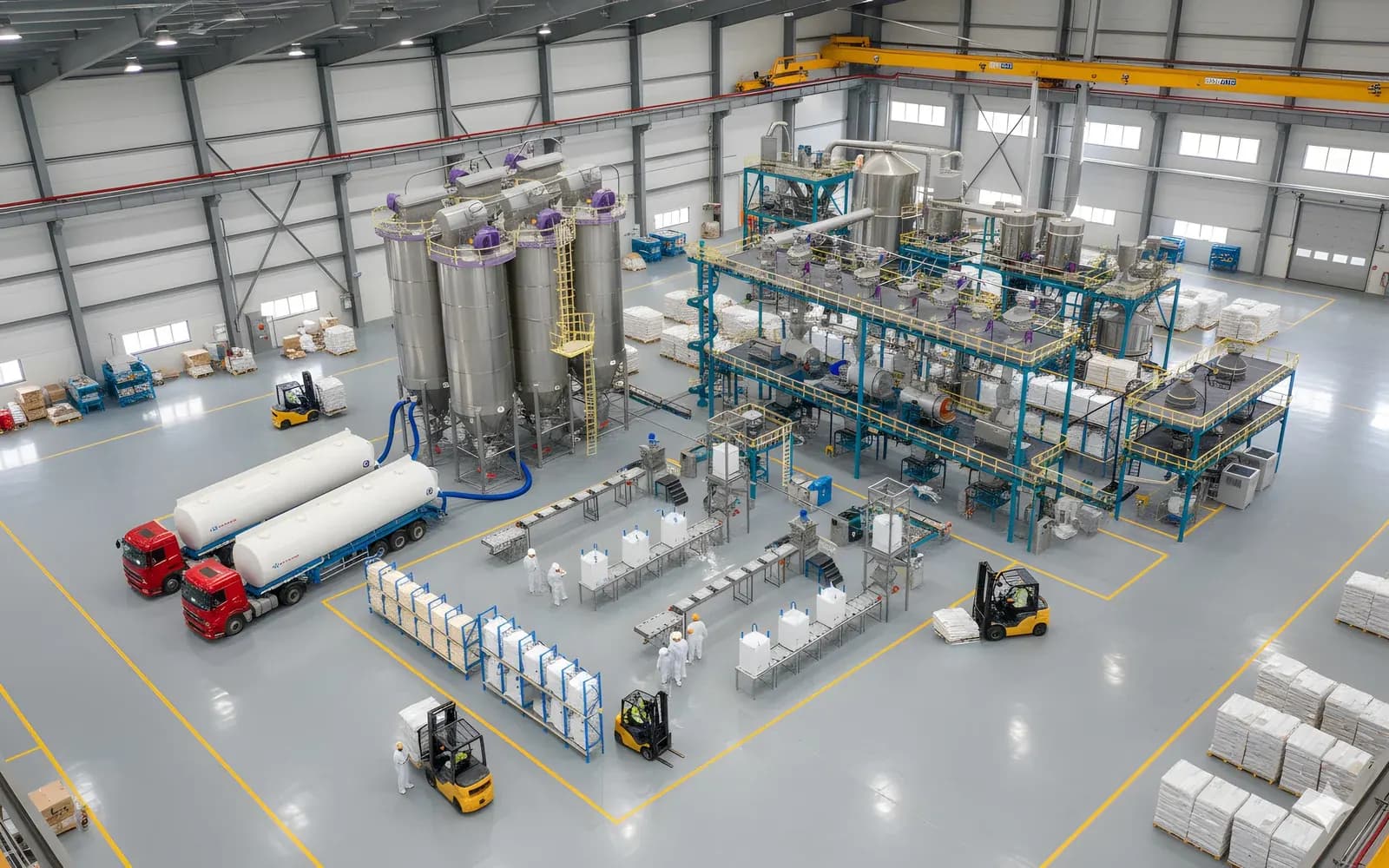
Bulk material handling covers the equipment and systems that move, store and meter dry solids in quantity — powders, granules, pellets and flakes — from delivery through storage and processing to dispatch. It spans intake stations, silos, pneumatic and mechanical conveyors, feeders, dust collection and loading equipment.
In detail
How it works.
Two powders with the same bulk density can behave nothing alike. One discharges freely from a shallow hopper; the other arches over the outlet, packs under its own weight and picks up moisture overnight. Bulk density, particle size distribution, moisture content, cohesiveness, abrasiveness and friability are the properties that set the design.
Transfer splits into pneumatic and mechanical. Pneumatic lines are fully enclosed, route around plant obstructions in three dimensions and serve several destinations from one source, at the cost of air power and some degradation. Mechanical conveyors — screw, flexible screw, vibratory — are gentler and cheaper to run but follow a fixed straight route.
Storage and discharge are where most nuisance problems live. Bridging, ratholing, flushing and segregation all trace back to hopper geometry and wall finish chosen without reference to how the material actually flows. Discharge aids such as bin activators, fluidising pads and air cannons should back up a correct geometry, not compensate for a wrong one.
Every transfer point is also a dust source and a contamination risk. Capture at the source, sieving, magnetic separation and metal detection belong in the design from the start, because retrofitting extraction onto a running line is always more expensive and rarely as effective.
PTP's range covers the whole chain: bulk tankers and their loading and unloading accessories, rigid and flexible silos, mobile bins, pneumatic and mechanical conveying, feeders, sifters, mixers, grinding, dust collection, packing, and the control system that sequences them.
Scope
What we engineer and supply.
Selection
How the system gets specified.
- Properties that drive design
- Bulk density, particle size distribution, moisture, cohesiveness, abrasiveness, friability and aeration behaviour.
- Pneumatic or mechanical
- Pneumatic where the route is complex, containment matters or several destinations are served; mechanical where the route is straight and the material is fragile or abrasive.
- Storage
- Rigid stainless and aluminium silos outdoors; flexible and fiberglass silos indoors; mobile bins and day hoppers at the process.
- Materials of construction
- Stainless steel 304 or 316 for food, dairy and pharma contact; mild steel, aluminium and coated finishes elsewhere.
- Product protection
- Sieving, magnets, metal detection and dehumidified conveying air where the powder is hygroscopic.
- Controls
- PLC sequencing, weighing and batching integration, level and inventory monitoring, remote support.
FAQ
Frequently asked questions.
What counts as bulk material handling equipment?
Anything that moves, stores, meters or protects dry solids in quantity: intake stations, silos and bins, pneumatic conveying lines, screw and vibratory conveyors, feeders, sifters, mixers, dust collectors, and bag or tanker loading equipment.
Pneumatic or mechanical conveying — which is better?
Neither in the abstract. Pneumatic is enclosed, routes in three dimensions and can serve several destinations, but uses air power and can degrade fragile product. Mechanical is gentler and cheaper to run over a straight route but cannot turn corners without a transfer point.
Why does material stop flowing out of a hopper?
Usually because the outlet is too small or the hopper walls too shallow for the powder's cohesive strength, so an arch forms and supports itself. Fine, moist or long-stored powders are the worst offenders. Correct geometry solves it; discharge aids should only be a backup.
Does PTP handle installation and commissioning?
Yes. PTP designs, supplies, installs and commissions complete systems from its Bengaluru base, and supports them afterwards with spares, retrofits and maintenance contracts.
Where to next
Related pages.
Discuss your powder handling project.
Talk to an engineer.
Send the material, the throughput and the plant constraints. An engineer will come back with a route, not a brochure.