
SOLUTIONS — AIR QUALITY
Dust Collection Systems
Cartridge, Baghouse, and Cyclone Systems—Designed as Part of the Process Line
At Paul Techno Process (PTP), we design industrial dust collection systems directly integrated into your powder handling process. Whether configured as a centralized unit serving multiple pick-up points or point-of-use collectors installed on individual machines, our systems ensure clean air, worker safety, and regulatory compliance. While choosing filter media is straightforward, the capture hood design and ducting layout dictate whether a system performs or fails.
In short
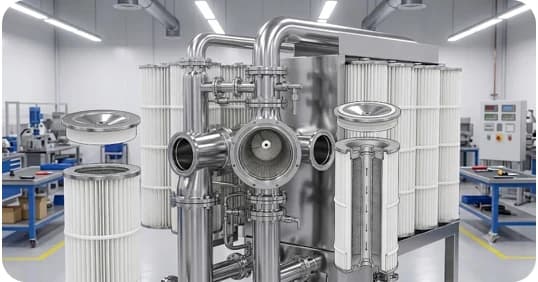
An industrial dust collection system captures airborne particles at the exact point of generation, draws them through engineered ducting to a filtration unit, and returns clean air back to the plant floor or atmosphere. Cartridge or fabric bag filter elements trap the dust, while automated reverse-pulse jets of compressed air knock the collected cake down into a discharge hopper for disposal or product recovery
In detail
How it works.
Most dust collection failures are capture failures. If the hood is too far from the source, too small, or fighting a cross-draught from an open door, the dust is already in the room before the fan sees it. PTP sizes capture velocity at the source first, then works back through the ducting to the filter and the fan.
Ducting is where designs quietly go wrong. Transport velocity must stay high enough to keep dust airborne along the whole run; too low and material settles until a branch chokes, too high and abrasive dust cuts through bends. Balanced take-offs, blast gates and correctly angled entries keep each branch pulling its designed share.
The filter itself is a straightforward choice between bag and cartridge. Bag filters handle high dust loading, coarse and fibrous dust, and higher temperatures. Cartridge collectors pack far more media into the same footprint and suit fine dry dust. Both are cleaned by a reverse pulse of compressed air, timed on differential pressure rather than on a clock.
Combustible dust changes the design rather than the equipment list. Flour, sugar, milk powder, starch, many pigments and most plastics form explosible clouds. The response is explosion venting or suppression on the collector, isolation on the ducting so a flame front cannot travel back to the process, correct earthing throughout, and no accumulation surfaces in the layout.
Where the dust is the product, recovery matters as much as emission. Filter receivers, cyclone pre-separators and rotary airlock discharge return usable powder to the line instead of a waste bin — which is the difference between dust collection as a cost and as a yield measure.
Scope
What we engineer and supply.
Selection
How the system gets specified.
- Filter media
- Pleated cartridges for fine dry dust in a small footprint; bag or sleeve filters for high loading, coarse, fibrous or hot dust.
- Cleaning
- Reverse-jet compressed air pulses triggered on filter differential pressure, on-line or off-line depending on duty.
- Layout
- Centralised units serving several pick-up points, or individual collectors dedicated to one machine, chosen on duty cycle and cross-contamination risk.
- Materials of construction
- Stainless steel housings and ducting for food, dairy and pharma; mild steel with paint elsewhere.
- Combustible dust
- Explosion venting or suppression, ducting isolation, conductive filter media and continuous earthing where the dust is explosible.
- Options
- After-filters, product recovery back to the line, silencers, differential-pressure monitoring and remote alarms.
FAQ
Frequently asked questions.
Cartridge collector or bag filter?
Cartridge collectors pack more filter area into a smaller footprint and suit fine, dry, free-flowing dust. Bag filters cope better with high dust loading, coarse or fibrous dust, moisture and higher temperatures. Duty and dust characteristics decide it, not price.
Should dust collection be centralised or individual?
A central unit is cheaper to run and maintain when several pick-up points operate on similar duty cycles. Individual collectors are better where products must not cross-contaminate, where machines run intermittently, or where a long duct run would cost more than a second collector.
How is combustible dust handled?
By treating the collector as a vessel that can hold an explosible dust cloud. That means explosion venting or suppression, isolation on the inlet duct so a flame front cannot travel back into the process, conductive media, continuous earthing, and a layout that gives dust nowhere to accumulate.
Can collected dust be returned to the process?
Often, yes. Where the dust is the product — flour, milk powder, pigment, resin fines — a filter receiver or cyclone with a rotary airlock discharge returns it to the line. That turns the collection system into a yield measure rather than a running cost.
Where to next
Related pages.
Discuss your powder handling project.
Talk to an engineer.
Send the material, the throughput and the plant constraints. An engineer will come back with a route, not a brochure.