
Industries
Pharmacontained, cleanable, documented.
In pharma the question is rarely how fast the powder moves. It is whether the operator is exposed, whether the previous batch is really gone, and whether the paperwork proves both.
In short
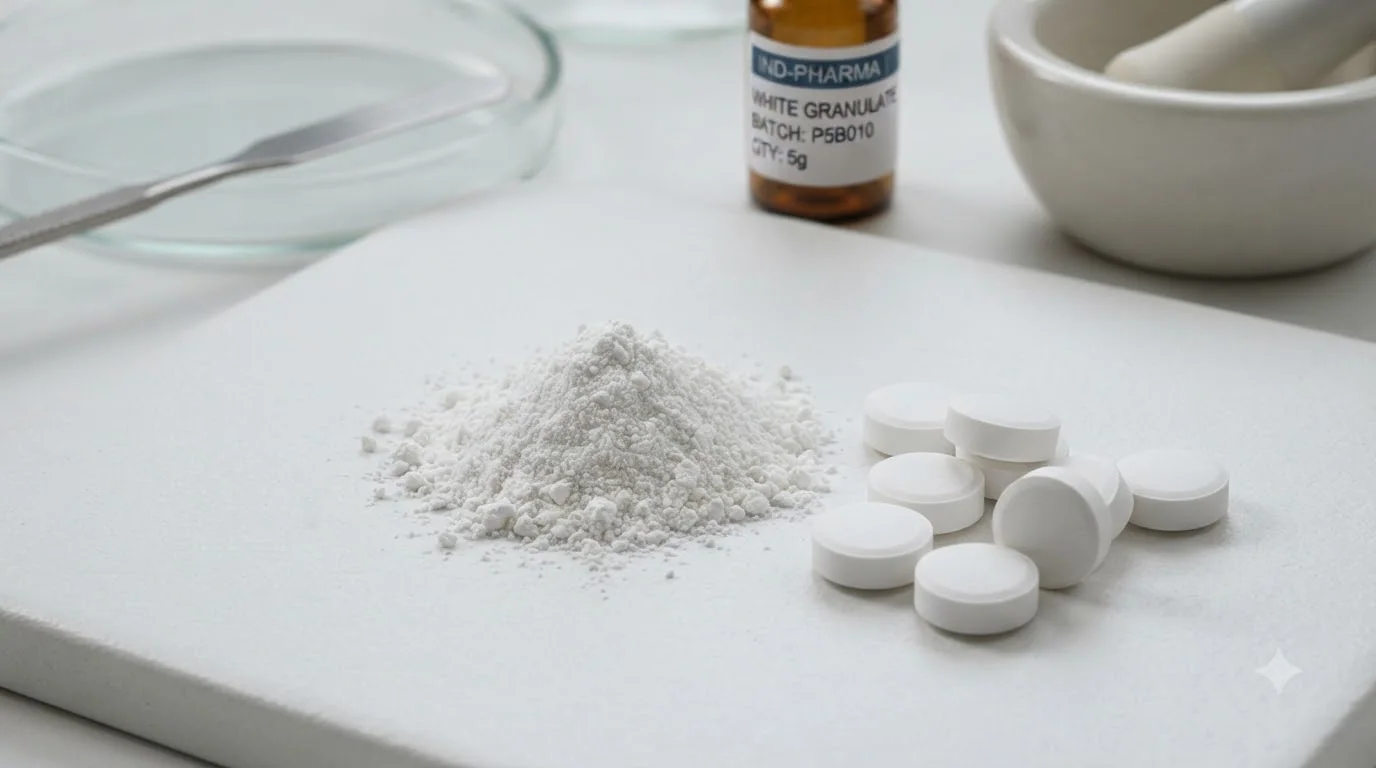
Pharmaceutical powder handling covers the contained charging, transfer, sieving, blending and discharge of active ingredients and excipients. Systems are designed around operator exposure limits and GMP cleanability rather than throughput, using closed transfer, crevice-free product contact surfaces, verifiable cleandown and documented material traceability.
In detail
How these materials behave.
Containment sets the design. Actives are banded by occupational exposure, and each band tightens what is acceptable at every open point in the process — bag opening, charging, sampling, discharge, filter change. The general progression runs from local extraction and good practice at the low bands, through contained charging stations and closed transfer, to fully closed systems with split-butterfly or comparable isolation at the high bands. Vacuum transfer is favoured because a leak in a vacuum line draws air in rather than pushing active dust out, which fails safe in the direction that matters.
Cleanability has to be demonstrable, not merely plausible. Product contact surfaces are polished to a specified finish, drainage is designed in, and every seal, gasket and dead volume is treated as a potential carry-over point. Where equipment cannot be cleaned in place to a defensible standard it is designed to be dismantled and cleaned off-line, or made single-use. The practical test is whether a swab and a rinse sample can reach the worst-case location; if they cannot, the design is wrong regardless of how clean it looks.
Powder behaviour is its own problem. Micronised actives are cohesive, electrostatically active and low in bulk density, so they bridge in hoppers, rathole in bins and cling to every surface. Excipients — lactose, microcrystalline cellulose, starch, mannitol — flow very differently from each other and from the active, which makes blend uniformity a real risk when charge order and transfer route are chosen carelessly. Gentle handling matters too, since granules built for compression behave badly if the transfer route grinds them back to fines.
Finally, everything has to be documented. Materials of construction, surface finishes, weld records, instrument calibration and control system behaviour all form part of the qualification package, and change control follows the plant for its life. A system that works but cannot be evidenced is not usable in a regulated plant, so engineering documentation is part of the deliverable rather than an afterthought.
Scope
What PTP supplies to this sector.
Selection
Process requirements.
- Typical materials
- Actives, lactose, microcrystalline cellulose, starch, mannitol
- Design driver
- Operator exposure containment and verifiable cleandown
- Transfer preference
- Closed and vacuum transfer — leaks draw in rather than out
- Product contact
- Polished, drainable, crevice-free, dismantlable for cleaning
- Powder behaviour
- Cohesive, electrostatic, bridging and ratholing tendencies
- Documentation
- Material, weld, finish and calibration records for qualification
FAQ
Frequently asked questions.
Why is vacuum transfer preferred for potent powders?
Because a breach in a vacuum conveying line pulls air inwards instead of pushing powder outwards. Any leak therefore fails in the safe direction, keeping active dust inside the system. Positive-pressure lines carrying potent material need every joint to hold, which is a harder thing to guarantee over a plant's life.
What makes pharmaceutical equipment GMP-cleanable?
Product contact surfaces that are polished, drainable and free of crevices, dead legs and unsealed threads; seals seated so residue cannot hide behind them; and a design where the worst-case internal location can actually be reached by a swab or rinse sample. If it cannot be sampled, the cleaning cannot be validated.
How are minor ingredients dosed accurately?
By separating small-mass dosing from bulk charging. Minor ingredients are weighed on instruments sized for the small mass rather than the batch, dispensed through feeders that can trickle to target, and reconciled against the batch record. Sharing a large bulk weigh vessel with a small addition destroys resolution.
Where to next
Related pages.
Discuss your powder handling project.
Talk to an engineer.
Send the material, the throughput and the plant constraints. An engineer will come back with a route, not a brochure.