
Components
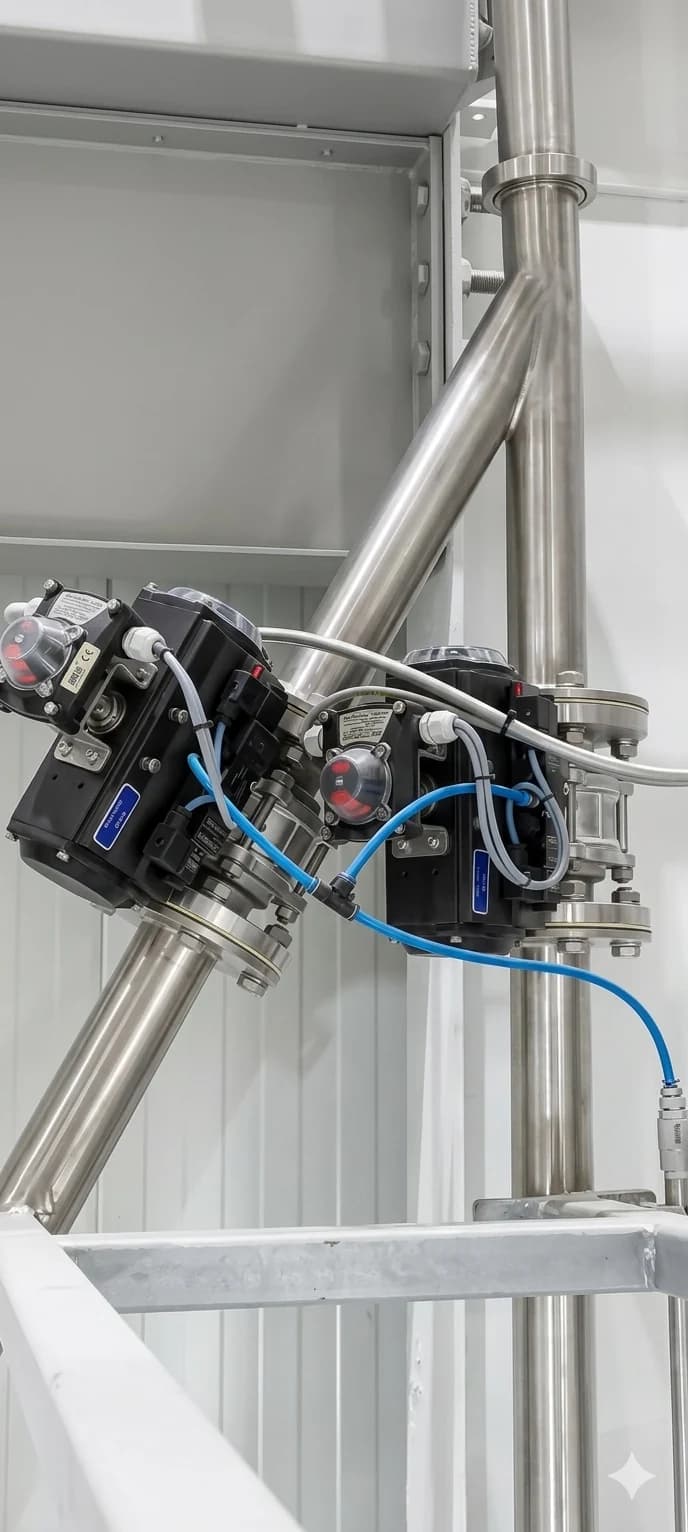
Isolation valvespneumatic and manual, for powder and air lines.
The valve that lets one part of the plant stop while the rest keeps running. Simple to specify badly, and expensive to get wrong on a powder duty.
In short
An isolation valve shuts off flow in a single line so a section of plant can be stopped, drained or opened for maintenance while the rest keeps running. In powder handling it also separates process stages — closing a hopper outlet during filling, or sealing a vessel before it is pressurised.
In detail
How it works.
Isolation sounds like a solved problem until the medium is a dry powder. A valve that seals perfectly on air or water can fail on flour, because a thin layer of product sits on the seat and the disc closes onto it instead of into it. Over a few hundred cycles that layer packs, the seat wears unevenly, and the valve stops sealing. The fix is not a better actuator — it is a seat form and a seal material chosen for a solid, not a fluid.
The two families do different work. Butterfly and slide gate valves handle powder in a chute or a hopper outlet, where the requirement is a full clear bore when open and a dust-tight shut-off when closed. Ball and disc valves handle the air, gas and liquid services around the process — blower lines, compressed air headers, cooling water, cleaning circuits. Getting a powder valve where an air valve was specified, or the reverse, is one of the more common inherited faults on an old line.
Pneumatic or manual is a question about how the valve is used, not about budget. Anything that has to move as part of an automated sequence, or that forms part of an interlocked shutdown, has to be pneumatic with position feedback — otherwise the control system is guessing. Anything operated at changeover, or only when a fitter is standing in front of it, can be manual. PTP supplies both, and the old plant list PTP has always worked to says exactly that: pneumatic and manual.
For a retrofit, the constraints are usually mechanical rather than functional. Face-to-face dimension, flange or clamp pattern, the headroom above and below, and whether there is instrument air at that point. Send those and the product being handled, and a valve can be selected that drops into the existing gap rather than forcing pipework changes.
Scope
Types and options.
Selection
How it gets specified.
- Actuation
- Pneumatic where the valve moves inside an automated sequence or an interlock; manual where it is operated only at changeover or by a fitter during maintenance.
- Valve form
- Butterfly and slide gate for powder at a hopper outlet or in a chute; ball and disc valves for the air, gas, water and cleaning services around the line.
- Seat and seal
- Seat material chosen against product temperature, abrasion and whether the shut-off has to be dust-tight, pressure-tight or both.
- Cleaning regime
- Clamp connections and a smooth bore where the line is stripped between products; flanged or welded where the valve stays in place and is cleaned in situ.
- Position feedback
- Limit switches or a sensor arrangement so the control system can prove open and closed before allowing the next step to run.
FAQ
Frequently asked questions.
What is an isolation valve?
A valve whose only job is to stop flow in one line so that part of the plant can be worked on, filled, emptied or sealed while the rest carries on. It is not a control valve and is not intended to run partly open — it is specified to seal fully closed and pass fully open, and specifying it for anything in between shortens its life.
Pneumatic or manual isolation valve — which should be specified?
Pneumatic if the valve has to move as part of an automatic sequence, if it forms part of a safety interlock, or if it is somewhere awkward to reach. Manual if it is operated occasionally, at ground level, and nothing in the control system needs to know its position. Position feedback is what usually settles the argument.
Why do isolation valves fail on powder lines?
Almost always the seat. A layer of product sits on the sealing face, the valve closes onto it rather than into it, and the seat packs and wears unevenly. Add abrasion and repeated cycling and the shut-off degrades. Choosing a seat form and material intended for a solid, and mounting the valve so product does not lie on the seat, prevents most of it.
Where to next
Related pages.
Discuss your powder handling project.
Talk to an engineer.
Send the material, the throughput and the plant constraints. An engineer will come back with a route, not a brochure.