
Components
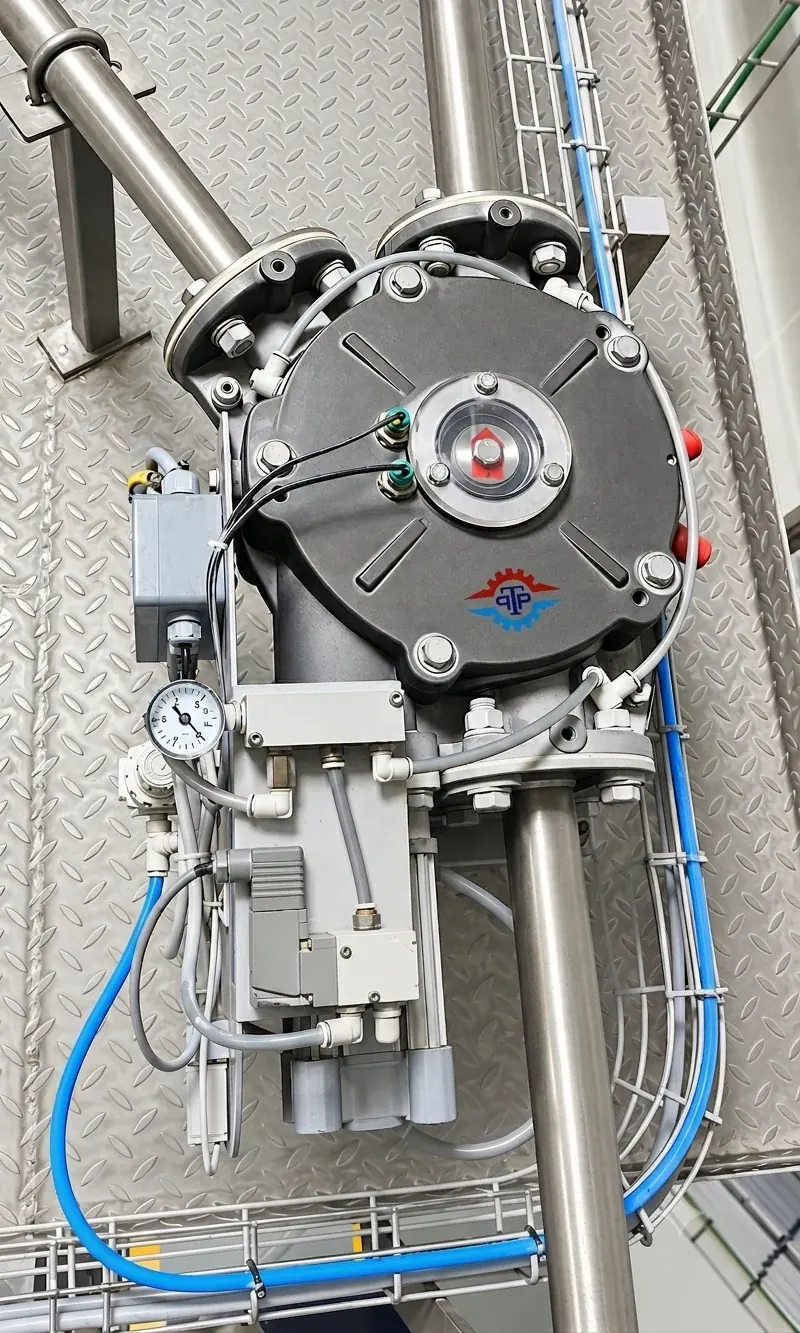
Diverter valvestwo-way and multi-port, pneumatically actuated.
One conveying line, several destinations. A diverter valve routes the product without anyone climbing up to swing a pipe by hand.
In short
A diverter valve routes a single conveying line to more than one destination. A pneumatically actuated plug, blade or tunnel body moves to align the inlet with the chosen outlet, so one pickup point can feed several silos, bins or packing heads without breaking the line or dismantling pipework.
In detail
How it works.
Before a diverter goes in, changing destination on a conveying line means undoing a coupling and physically swinging a bend across to another port. It works, and plenty of plants still run that way. What it costs is time at every changeover, a person at height, and the standing risk that someone points the line at the wrong silo. A pneumatically actuated diverter takes that decision into the control system, where it can be interlocked against the batch record.
The internal form matters more than the actuator. A tunnel or plug body keeps a smooth, continuous bore through the valve in either position, which is what a conveying line needs — any step or dead pocket becomes a wear point and a place for product to sit between batches. Blade and flap types are simpler and cheaper, and they are perfectly good on a gravity chute or a dust extraction duct where there is no conveying velocity to worry about.
Multi-port units extend the same idea. Where a single receiving point has to feed a row of silos or a bank of day bins, a multi-port diverter indexes to the selected outlet rather than stacking two-way valves in series. Fewer joints, one actuator to maintain, and one position signal for the control system to prove before the blower starts.
Sealing and changeover are where product knowledge decides the specification. A paint or pigment line changing colour needs a valve that seals hard and cleans out completely, because carry-over shows up in the next batch. A food line needs a finish and a seal material that survives the cleaning regime. An abrasive mineral needs a wear-tolerant body and a plan for replacing the seals rather than the whole valve.
Scope
Types and options.
Selection
How it gets specified.
- Configuration
- Two-way where one line serves two destinations; multi-port where a single pickup feeds a row of silos, bins or packing heads from one valve body.
- Internal form
- Tunnel and plug bodies hold a continuous bore for conveying duty; blade and flap types suit gravity chutes and dust lines with no conveying velocity.
- Actuation
- Pneumatic actuation wired into the plant control system for automated changeover; manual levers where the destination changes rarely and access is easy.
- Seals and finish
- Elastomer seal material and internal finish chosen for the product — food contact, colour changeover in paint, or an abrasive mineral duty.
- Position proving
- Limit switches or proximity sensors so the control system confirms the port has actually moved before the conveying cycle is allowed to start.
FAQ
Frequently asked questions.
What is a diverter valve used for in pneumatic conveying?
It sends the conveyed product to a chosen destination without anyone rebuilding pipework. One pickup point — a bulk bag unloader, a bag dump station, a receiving bay — can then feed several silos, day bins or packing heads. The valve is actuated from the control system, so the destination becomes part of the recipe rather than a manual step.
Should a diverter valve be pneumatic or manual?
Pneumatic where the destination changes often, where the valve is at height or in a dusty area, or where the control system needs to interlock destination against the batch record. Manual is reasonable where changeover happens rarely, access is safe and there is no traceability requirement attached to which line was used.
Can a diverter valve be fitted to an existing conveying line?
Usually, yes. The practical constraints are the straight run available either side of the valve, the flange or coupling arrangement, and whether there is compressed air and a control signal at that point. PTP supplies diverters individually for retrofit work, including into lines PTP did not originally engineer.
Where to next
Related pages.
Discuss your powder handling project.
Talk to an engineer.
Send the material, the throughput and the plant constraints. An engineer will come back with a route, not a brochure.