
Screening
Sifters and sieving systemsrotary and vibratory screening.
Screening earns its place three times over — at intake, in the middle of the process, and immediately before packing. PTP supplies rotary and vibratory sifters and integrates them with magnets and metal detection.
In short
A sifter, or sieve, separates bulk material by particle size through a screen mesh. In process plants it is used three ways: to screen incoming raw material for foreign matter, to grade a product into size fractions, and as a final safety sieve that guards the packing line against contamination.
In detail
How it works.
A vibratory sifter is a circular or rectangular screen deck driven by an unbalanced motor. The vibration pattern is adjustable, so material can be made to spiral outward across the mesh for maximum residence time or to travel straight across for throughput. Multiple decks separate a feed into several fractions in one pass.
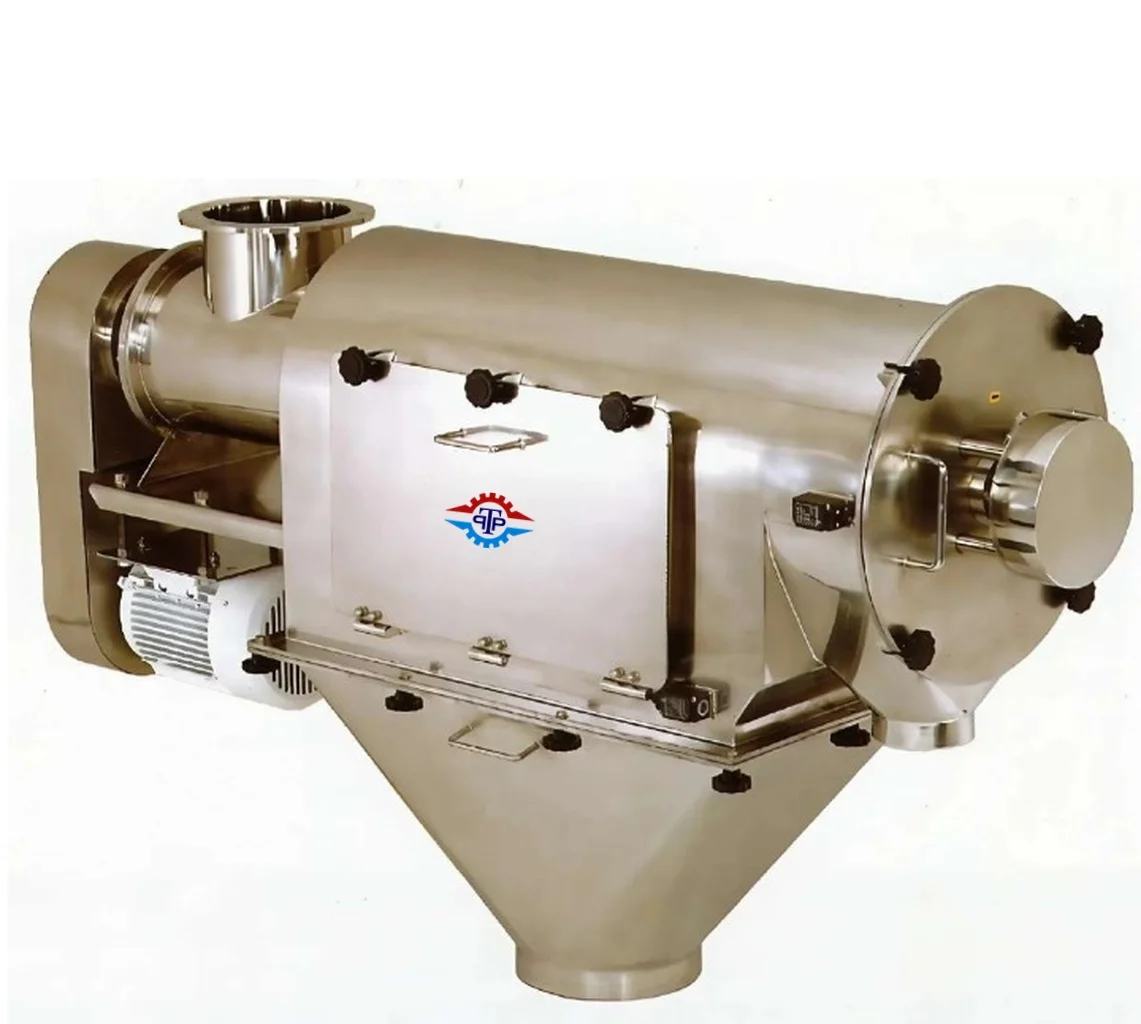
A rotary or centrifugal sifter is a horizontal cylindrical screen with a rotating paddle assembly inside. The paddles throw material against the mesh, which pushes fines through faster than gravity alone would and breaks soft agglomerates on the way. It is the usual choice for fine, cohesive powders and for high-rate in-line safety sieving.
Safety sieving is a different duty from grading. The screen is not there to classify — it is there so that nothing larger than the aperture ever reaches the packing machine. Oversize is small, collected in a dedicated reject vessel and inspected, because what appears there tells the plant something has gone wrong upstream.
Mesh selection is where sieving specifications go wrong. Aperture size, wire diameter, open area and mesh tension all affect throughput and blinding. Fine, moist or fatty powders blind the mesh quickly, and screen-cleaning devices — sliders, balls or brushes — are chosen against the specific powder rather than fitted as standard.
Sifters rarely stand alone. A magnet before the screen catches ferrous fragments, a metal detector after it catches non-ferrous, and dust extraction at the feed and discharge keeps the area clean. PTP supplies the sifter as part of that group rather than as a single machine.
Scope
What we engineer and supply.
Selection
How the system gets specified.
- Rotary or vibratory
- Rotary and centrifugal sifters for fine cohesive powders, agglomerate breaking and high-rate in-line safety sieving; vibratory screens for grading into fractions.
- Duty
- Intake screening for foreign matter, mid-process grading into size fractions, or final safety sieving ahead of packing.
- Screen media
- Aperture, wire diameter, open area and tension chosen against the powder, with screen-cleaning devices where the material tends to blind the mesh.
- Materials of construction
- Stainless steel 304 or 316 contact parts with tool-free screen changes for food, dairy and pharma; mild steel elsewhere.
- Product protection
- Grate or drawer magnets before the screen, metal detection after it, and a dedicated reject vessel for oversize.
- Options
- Multi-deck configurations, dust-tight enclosures, local extraction, quick-release clamps and CIP-compatible arrangements.
FAQ
Frequently asked questions.
Rotary sifter or vibratory sifter?
A rotary or centrifugal sifter uses paddles to throw material against the mesh, which suits fine cohesive powders, breaks soft agglomerates and gives high in-line throughput. A vibratory screen is better where the job is to grade a free-flowing material into two or more size fractions.
What is a safety sieve?
A final screen immediately before packing whose only job is to ensure nothing oversize reaches the pack. It is not there to classify, so oversize volumes should be tiny — and when they are not, the reject is evidence that something upstream needs attention.
Why does a screen blind, and what stops it?
Fine, moist or fatty powders lodge in the apertures until throughput collapses. Screen-cleaning devices — sliders, rubber balls or rotating brushes under the mesh — keep the apertures clear, and are selected against the specific material rather than fitted by default.
Where should sieving sit in a powder line?
At intake, to catch foreign matter before it enters the process; wherever the process needs a defined particle size; and immediately before packing as a safety sieve. Magnets and metal detection normally sit either side of the screen.
Where to next
Related pages.
Discuss your powder handling project.
Talk to an engineer.
Send the material, the throughput and the plant constraints. An engineer will come back with a route, not a brochure.