
SOLUTIONS — FEEDING
Vibratory Feeders
Tube and Tray Feeders for Controlled, Repeatable Dosing
Where a mechanical screw conveyor would grind delicate material and a belt conveyor would spill it, a vibratory feeder provides gentle, contact-free advancement. Product moves forward in small micro-hops with nothing touching it except the sanitary surface of the tray or tube. Paul Techno Process (PTP) supplies vibratory tube and tray feeders fully integrated into automated batching, sieving, and packing lines.
In short
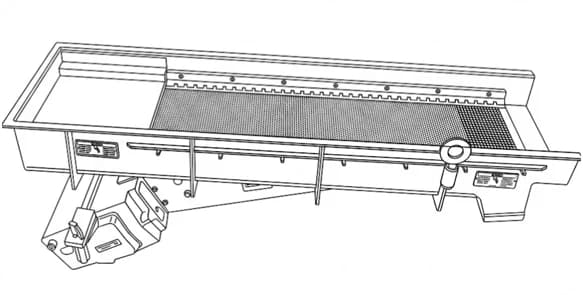
A vibratory feeder moves bulk material along an open tray or enclosed tube using controlled directional vibration. Each vibration cycle throws particles slightly upward and forward in short hops, advancing material cleanly without subjecting it to friction, pushing, dragging, or mechanical shearing. Feed rates are controlled electronically by adjusting vibration amplitude, making these units exceptionally well-suited for precise batch dosing.
In detail
How it works.
The drive is usually an electromagnet pulsing against a spring-mounted tray. Each pulse throws the material forward at a shallow angle; gravity brings it back down slightly ahead of where it started. Because there is no rotating element in the product path, the feeder handles fragile, sticky and abrasive materials that would suffer in a screw.
Rate control is electronic and near-instant. Amplitude is varied from a controller, so the feeder can start, stop and change rate within a fraction of a second — which is what makes it the natural final device on a weigh-hopper fill, dribbling the last part of the batch to hit the target weight.
Tube feeders are fully enclosed and suit dusty, hygroscopic or contamination-sensitive powders. Open tray feeders are easier to inspect and clean, take multiple discharge points, and are commonly used to spread material evenly across the width of a sifter, a metal detector or an inspection belt.
There is very little to maintain. No shaft, no bearings and no seals in the product path means no lubrication near the product and nothing to wear against it. Springs and the drive coil are the only consumables, and the tray strips off for cleaning between products.
The material sets the limits. Very fine, cohesive or highly aerated powders can pack or flood on a vibrating tray rather than advance in a controlled way; those duties are usually better served by a metering screw or a rotary valve. PTP matches the feeder to the measured behaviour of the powder.
Scope
What we engineer and supply.
Selection
How the system gets specified.
- Tube or tray
- Enclosed tubes for dusty, hygroscopic or contamination-sensitive powders; open trays for inspection, easy cleaning and multiple discharge points.
- Drive
- Electromagnetic drives with electronic amplitude control for fast start, stop and rate change; unbalanced-motor drives for heavier duty.
- Where it suits
- Fragile, abrasive, sticky or heat-sensitive materials, and any duty needing fast, repeatable rate change.
- Where it does not
- Very fine cohesive powders that pack on the tray, and highly aerated powders that flood — better fed by a metering screw or rotary valve.
- Materials of construction
- Stainless steel 304 or 316 trays and tubes for food, dairy and pharma; mild steel or coated finishes elsewhere.
- Options
- Weigh-hopper interlocking, dust-tight covers, quick-release trays and spark-resistant construction where the dust is explosible.
FAQ
Frequently asked questions.
Vibratory feeder or screw feeder?
A vibratory feeder is gentler, has nothing rotating in the product path and changes rate almost instantly, which suits fragile product and weigh-hopper dosing. A screw feeder handles cohesive powders that would pack on a tray, runs fully enclosed as standard and manages higher continuous rates.
How accurate is vibratory feeding?
Accuracy comes from the control loop, not the tray. Paired with load cells in a gain-in-weight or loss-in-weight arrangement and a coarse-then-dribble sequence, a vibratory feeder is one of the more repeatable ways to hit a target batch weight.
Can vibratory feeders handle fragile products?
That is one of their main uses. The material hops along the tray rather than being pushed or sheared, so coated snacks, extruded product, tablets, crystals and pellets arrive with far less breakage than through a screw or a drop chute.
What maintenance does a vibratory feeder need?
Very little. With no bearings, shafts or seals in the product path, the springs and the drive coil are the only regular items. Trays and tubes come off for cleaning between products.
Where to next
Related pages.
Discuss your powder handling project.
Talk to an engineer.
Send the material, the throughput and the plant constraints. An engineer will come back with a route, not a brochure.