
SOLUTIONS — MECHANICAL CONVEYING
Flexible Screw Conveyors
Gentle Transfer Over Short, Elevated Routes
For short material transfers requiring vertical lift—such as hopper to mixer, bag dump station to weigh hopper, or silo discharge to packaging line—a flexible screw conveyor offers the simplest, most efficient transfer solution. Engineered with minimal components, these units navigate complex plant geometries and tight layouts without requiring complex mechanical drives or extensive footprint.
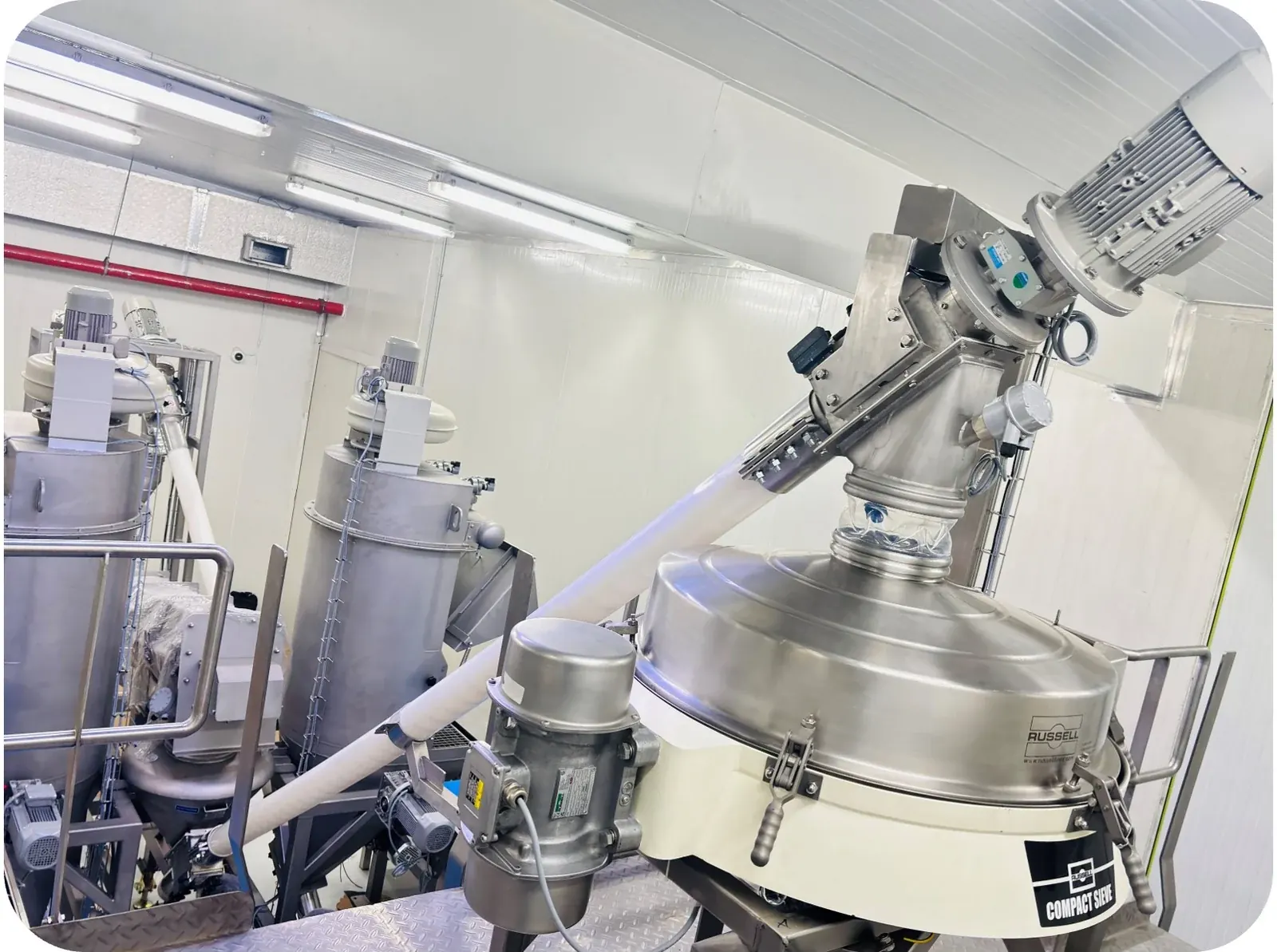
In short
A flexible screw conveyor moves bulk powders or granules using a single, continuous steel spiral rotating inside a sealed polymer outer tube. Designed without a centre shaft or intermediate internal bearings, the conveyor tube can be curved around plant obstacles and routed up steep inclines. For rapid maintenance and hygienic washdowns, the entire assembly strips down into two main components.
In detail
How it works.
The conveyor is a spring-steel spiral inside a flexible tube, driven from the discharge end. The spiral floats in the tube, so it self-centres as it turns and needs no intermediate bearings along the run. That single detail is why the tube can bend around plant obstructions and why there are no bearings in contact with product.
Because it is fully enclosed and driven from the top, the machine can lift. Angles of forty-five degrees and steeper are routine, and the same unit picks up at floor level and discharges above a mixer or a packing hopper. That combination of lift and containment in one machine is usually what decides the specification.
Spiral profile is chosen for the material. Round-wire spirals suit free-flowing powders; flat-wire suits larger granules and pellets; bevelled and square profiles suit sticky or agglomerating powders; and a tighter clearance or a hopper agitator is used where the material tends to pack.
Cleaning is the other reason plants choose them. The tube and spiral come apart in minutes with no bearings, seals or trough joints to strip, which makes the flexible screw a common choice on lines that change product frequently — spice blends, premixes, colour changes in a paint plant.
The limits are real and worth stating. Run lengths are short compared with a trough screw, throughput is modest, and highly abrasive material will wear the tube. Where the run is long or the duty continuous and heavy, a rigid screw or a pneumatic line is the better answer.
Scope
What we engineer and supply.
Selection
How the system gets specified.
- Where it fits
- Short runs with a lift, frequent product changeover, and duties where containment and quick cleaning matter more than throughput.
- Spiral profile
- Round wire for free-flowing powders; flat wire for granules and pellets; bevelled or square for sticky and agglomerating materials.
- Tube
- Food-grade flexible polymer tube, or rigid stainless tube where the route is fixed and hygiene requirements are stricter.
- Contact materials
- Stainless steel 304 or 316 spirals, hoppers and outlet spouts for food, dairy and pharma duties.
- Cleaning
- Spiral withdraws from the tube without tools; no intermediate bearings or seals in the product path.
- Options
- Trolley mounting, load-cell dosing, level control, hopper agitators and dust-tight bag-tip enclosures.
FAQ
Frequently asked questions.
How steep can a flexible screw conveyor run?
Steeply. Forty-five degrees is routine and near-vertical arrangements are used, which is why the machine is so often chosen to lift from a floor-level hopper to a mixer or packing hopper above. Capacity does fall as the angle increases.
Flexible screw or rigid screw conveyor?
Flexible wins on short lifted runs, frequent cleaning and awkward routes, and it has fewer parts. A rigid U-trough or tubular screw wins on long horizontal runs, high continuous throughput, abrasive materials and multiple inlets or outlets along the length.
Does a flexible screw conveyor damage the product?
Some attrition happens where the spiral rubs the tube wall, so very friable products need care. Matching spiral profile and clearance to the material, and running at the lowest speed that meets the rate, keeps degradation low.
How is a flexible screw conveyor cleaned?
The spiral is withdrawn from the tube and both are washed or wiped down. There are no intermediate bearings, trough joints or shaft seals in the product path, so a changeover takes minutes rather than a shift.
Where to next
Related pages.
Discuss your powder handling project.
Talk to an engineer.
Send the material, the throughput and the plant constraints. An engineer will come back with a route, not a brochure.