
What is bulk material handling?
A bulk handling line is not one machine. It is a sequence of equipment families, each solving a different part of the same problem: getting a loose solid where it needs to be, in the condition it needs to be in.
In short
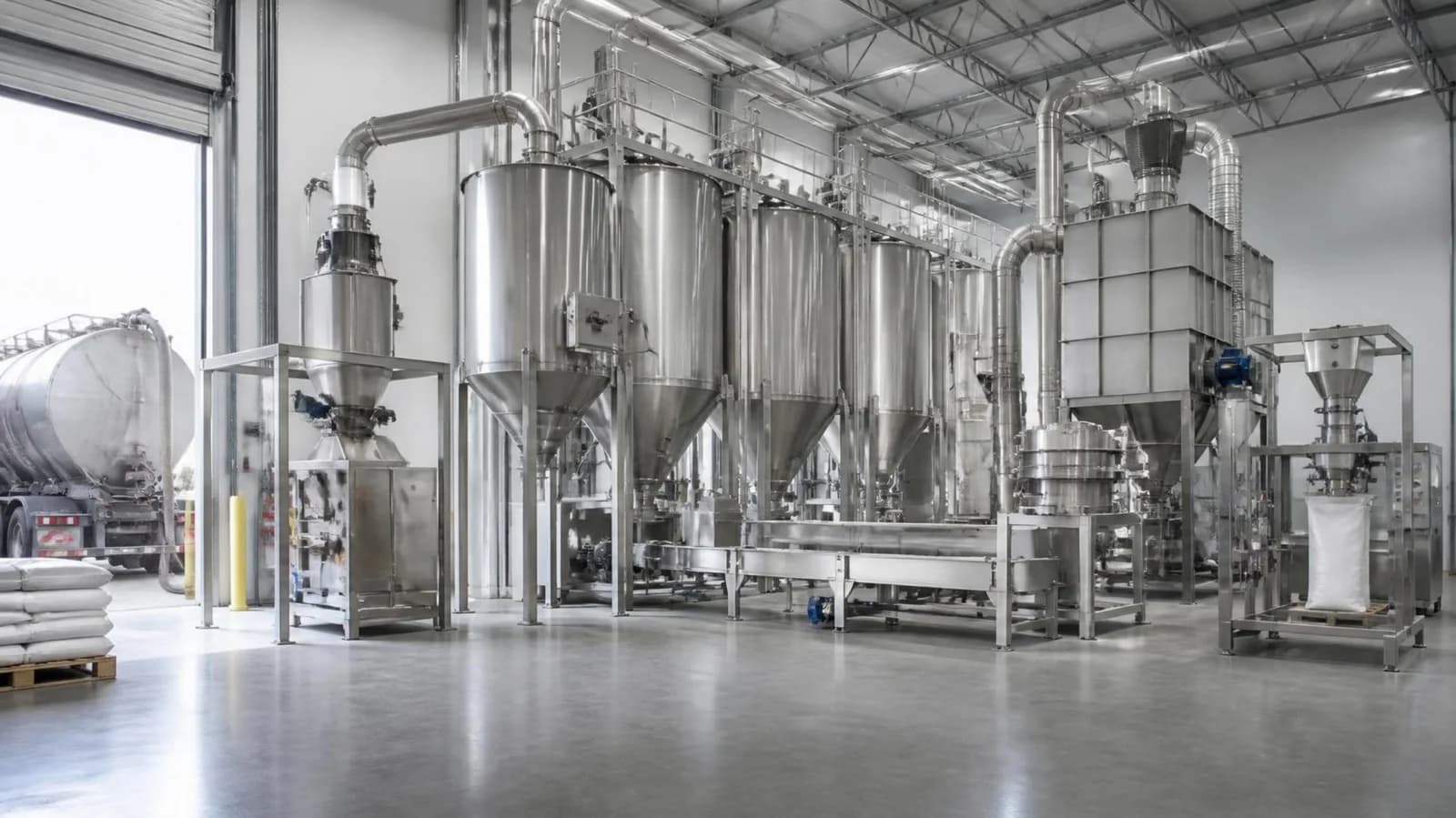
Bulk material handling is the storage, transfer, feeding, weighing and packing of loose dry solids — powders, granules, pellets and flakes — in industrial quantities. A line typically combines intake and unloading equipment, silo or bin storage, pneumatic or mechanical conveying, feeders, separation, dust collection, packing and the control system that sequences them.
What counts as bulk material, and why it is difficult
Bulk material means solids handled loose and in quantity rather than as discrete items: flour, cement, resin pellets, pigments, salt, milk powder, plastic granules. Unlike a liquid, a bulk solid has no single set of flow properties. Its behaviour depends on particle size and shape, moisture, how long it has been sitting under its own weight, and even how it was filled into the vessel.
That is why bulk handling is an engineering discipline rather than a catalogue exercise. The same silo geometry that discharges sand reliably will let a cohesive powder arch over the outlet, and a screw sized on volumetric capacity will not deliver rated throughput if the material will not fall into the flights.
Practically, every bulk line has to answer four questions. Will the material flow when we want it to? Will it stay put when we do not? Will it survive the journey? And can we keep it out of the air and off the floor?
Intake and unloading
Material arrives as sacks, big bags, drums or in bulk. Each has its own equipment. A bag dump station gives an operator a hooded tipping point with extraction, a grille and a small hopper below. A bulk bag unloader supports a big bag, opens its spout inside a contained enclosure, and provides massaging or agitation for material that has consolidated in transit.
Bulk deliveries come by road or rail. A dry bulk tanker discharges pneumatically into a silo, which means the receiving silo needs a vent filter sized for the tanker's blower and pressure relief in case that filter blinds — the most common cause of silo damage in the industry.
Intake is also the natural place to clean the material. Sieving here removes bag fibre, string and lumps before they reach a mill, mixer or filler, and a magnet catches ferrous tramp metal at the point where it is easiest to intercept.
Storage: silos, bins and hoppers
Storage decouples supply from production. Rigid silos in stainless steel or aluminium suit permanent outdoor or indoor duty; flexible and fiberglass silos suit lighter duties, indoor installation and situations where a fabricated steel vessel is more than the job needs. Mobile bins move batched material between operations.
The hopper is the part that matters. Outlet size, wall angle and internal finish decide whether material discharges in mass flow, where everything moves together, or funnel flow, where a central channel empties and the rest stays put. Funnel flow causes ratholing, first-in-last-out ageing and irregular discharge — which then ruins downstream weighing accuracy.
Where geometry alone is not enough, discharge aids do the rest: vibration, air fluidisers, agitators, or a live-bottom arrangement. These are corrections for difficult material, not substitutes for a hopper designed around how the powder actually flows.
Conveying and feeding
Conveying moves material between points; feeding controls the rate at which it arrives. They are different jobs and often different machines. Pneumatic conveying uses air in a sealed pipeline and suits long, complex or multi-destination routes. Mechanical conveying — screw conveyors, flexible screw conveyors, belts, chain conveyors, bucket elevators — carries material on a moving element and suits short, fixed routes at higher tonnage and lower power.
Feeders sit between storage and process. A metering screw feeder delivers a controlled volumetric or gravimetric rate. A vibratory feeder or tube feeder moves material gently along a trough, which suits fragile or abrasive product and gives fine control at low rates. Rotary valves do a hybrid job: they meter, and they seal a pressure difference between a vessel and a conveying line.
Diverter valves let one pipeline serve several destinations, which is what makes pneumatic routing so flexible in a multi-product plant. The seat design matters, because a diverter that leaks past its seal cross-contaminates two products quietly.
Processing, separation and dust control
Between transfer stages, most lines do something to the material. Grinding and milling reduce particle size. Mixers and blenders combine ingredients to a specified uniformity. Sifters and rotary or vibratory screens grade material and remove oversize. Classifiers such as zig-zag units separate by size and density in an air stream. Coolers bring hot product down before it is bagged, since bagging warm powder causes caking in the bag.
Separation for protection runs alongside separation for product. Magnetic separators pull ferrous contamination; metal detectors catch non-ferrous and stainless fragments that a magnet cannot; both are placed where the material stream is thin and moving.
Dust collection ties the whole line together. Every transfer, tipping and filling point generates airborne dust, and it has to be captured at source, ducted at a velocity that keeps it entrained, and filtered. In a line handling combustible dust this is a safety system, with earthing, venting or suppression and duct isolation designed in from the start.
Packing, weighing and control
At the end of the line, finished product goes into small bags, big bags, drums, bulk tankers or ISO containers. Each filling method has its own equipment and its own dust and accuracy problem: high-speed small bag filling is a rate challenge, big bag filling is a stability and deaeration challenge, and tanker loading is about getting a dusty stream into a vessel without emissions.
Weighing appears at several points — intake reconciliation, batch weighing, minor ingredient dosing, final pack check. Resolution has to match the mass being weighed, which is why small additions belong on their own instruments rather than on the batch vessel's load cells.
The control system is what turns a set of machines into a plant. It sequences transfers, interlocks equipment so a valve cannot open into a running line, manages recipes and batch records, handles alarms, and provides the operator interface. Without it, a bulk line is a collection of local starters and a person with a clipboard.