
Pneumatic vs mechanical conveying
Both methods move the same powder from A to B. They fail in completely different ways, which is what should actually decide the choice.
In short
Pneumatic conveying moves bulk material through a sealed pipeline using air, while mechanical conveying carries it on a moving machine element such as a screw, belt or chain. Pneumatic systems offer flexible routing and full containment; mechanical systems handle high throughput over short, fixed routes at lower power per tonne.
The fundamental difference: a pipe or a machine
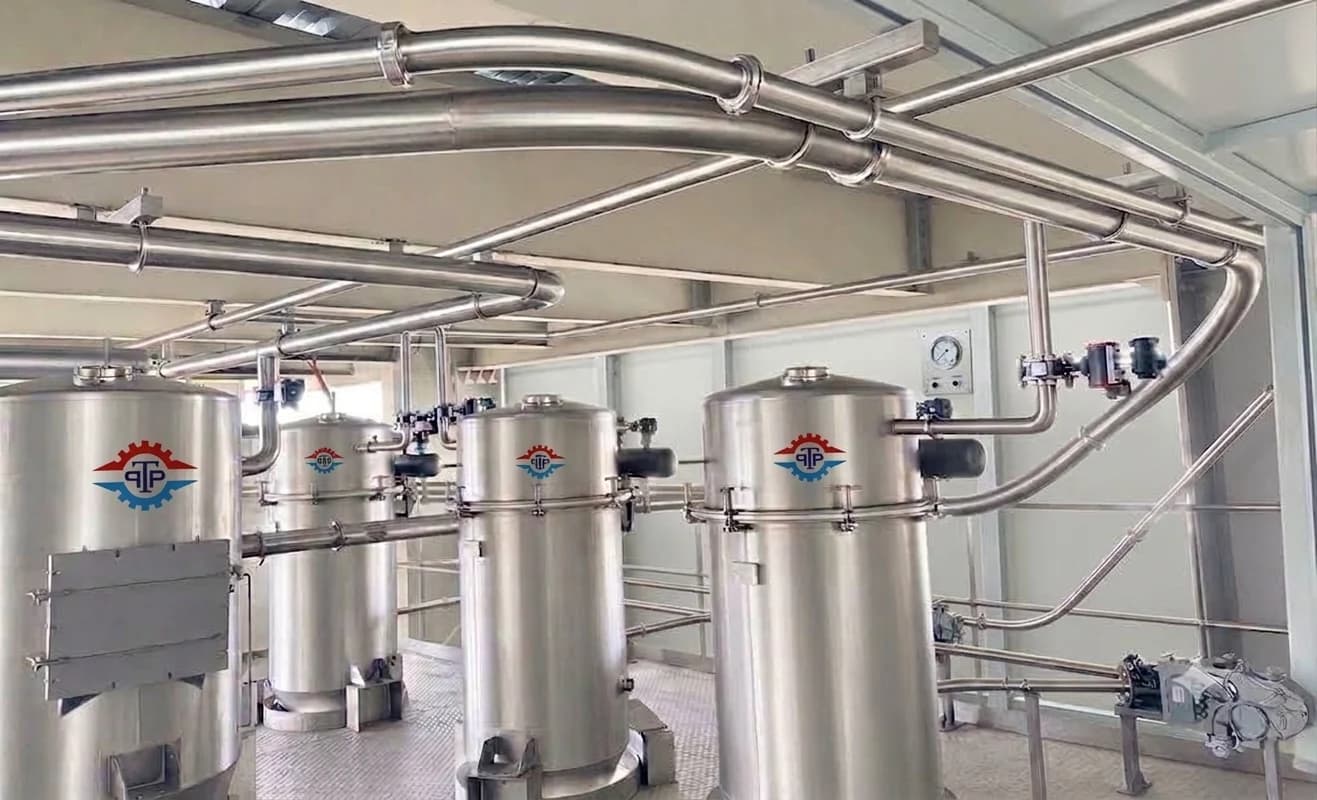
In pneumatic conveying the transport path is a pipe and the moving part is the air. A blower, fan or compressor creates the pressure difference, the material is fed in at a pickup point, and it travels to a receiver where it separates from the air through a filter or cyclone. The only mechanical parts are at the ends — the air mover, the feeder or rotary valve, and the receiver.
In mechanical conveying the transport path is the machine. A screw rotating in a trough, a belt on rollers, a chain dragging flights through a casing, or a trough vibrating at a frequency that walks material along it. The material is carried, not entrained, and the machine is as long as the route.
That distinction drives everything else. A pipe is cheap per metre, easy to route, sealed and has almost no moving parts along its length. A machine is expensive per metre, has to be supported and aligned, needs maintenance along its whole length, but does not need to accelerate the material to air-borne velocity to make it move.
Route flexibility and plant layout
This is where pneumatic conveying wins most often. A pipeline can go up a wall, across a roof, around an existing structure and down into a vessel, and it can split to several destinations through diverter valves. Adding a second delivery point later means adding a diverter and more pipe, not another machine. In a congested or retrofit plant this alone often decides the question.
Mechanical conveyors are geometrically constrained. A belt is essentially horizontal or gently inclined. A screw can be inclined but loses capacity sharply as the angle rises, and a vertical lift needs a different machine — a bucket elevator or a vertical screw. Changing direction means a transfer point, and every transfer point is somewhere material can spill, degrade or hold up.
The corollary is that a short, straight, fixed route is exactly where mechanical wins. Feeding a mixer from the hopper directly above it does not need an air system, a filter and a receiver.
Containment, dust and hygiene
A pneumatic line is closed by nature. Nothing escapes between the pickup and the receiver, and if the system runs under vacuum, any breach draws air inwards rather than pushing product out. That is a strong argument for potent, toxic or dusty materials, and it is why contained pharmaceutical transfer is usually vacuum-based.
Mechanical conveyors are enclosed rather than sealed. A screw conveyor in a closed trough with a proper cover and shaft seals is clean in practice, but it has rotating shaft penetrations, a lid, and a length of joint to leak through. Belt conveyors are open by design and generate airborne dust at every loading and discharge point.
Cleanability cuts the other way. A flexible screw conveyor can be dismantled and its spiral withdrawn for cleaning in minutes, which is exactly what a food plant changing recipe needs. Proving a long pneumatic line is clean between allergens is considerably harder work.
Throughput, distance and power
Mechanical conveying is far more energy-efficient per tonne moved. It only has to overcome friction and lift the material; it does not have to compress air. Pneumatic conveying pays for the air, and the higher the velocity and the longer the line, the more it pays. For high tonnages over short distances — the classic bulk plant duty — mechanical is usually the cheaper answer both to buy and to run.
Pneumatic conveying scales differently. Its cost per metre is low, so long routes suit it, but capacity is limited by pipe size and available pressure. Pushing more material means a bigger bore and a bigger air mover, and at some point a second line is more sensible than a larger one.
There is a third factor that decides many real projects: what happens when it stops. A blocked pneumatic line has to be cleared, and clearing it in a plant with no access to a bend at roof level is unpleasant. A jammed screw usually announces itself on the motor current and is dealt with at floor level.
Product degradation and material behaviour
Dilute-phase pneumatic conveying suspends particles in a fast air stream, and every bend is an impact. Fragile agglomerates, coated particles, crystals and instant powders come out of a fast line with more fines than they went in with. Dense phase conveying at low velocity largely solves this, and so does mechanical conveying — but not always, because a screw shears material against the trough wall and can smear or compact heat-sensitive powders.
Abrasive materials reverse the argument again. Titanium dioxide or silica in a fast pneumatic line erodes bends; the same powder in a screw conveyor wears the flights and the trough. Neither is immune, but low-velocity dense phase conveying and hard-faced or wear-backed components are usually the more economical fix.
Cohesive and poorly flowing powders often decide themselves. If it will not feed reliably into a pickup point, no pneumatic design will save it, and a flexible screw with a properly designed hopper and discharge aid is the pragmatic route.
When to choose which
Choose pneumatic conveying when the route is long, awkward or has to reach several destinations; when the material must stay fully contained; when the plant is congested and pipework is the only thing that fits; when you want minimal equipment along the route; or when material has to be lifted a significant height. Use dense phase when the material is abrasive, friable or the line is long.
Choose mechanical conveying when the route is short, straight and fixed; when tonnage is high and power cost matters; when the material must be metered as it moves, as with a metering screw feeder; when the powder is cohesive, sticky or hard to feed into an airstream; or when frequent cleandown between products makes a strippable machine more valuable than a sealed pipe.
Most real plants use both, and the interesting engineering is at the interface. A screw feeding a rotary valve into a pneumatic line, or a pneumatic receiver discharging into a screw that meters into a mixer, is the normal arrangement. The right question is not which method is better but which one each leg of the route deserves.