
Remote support for process plants
Maintenance prolongs equipment life, minimises downtime and reduces cost. It is also the first thing to be deferred, and deferral compounds quietly until it arrives as an emergency.
In short
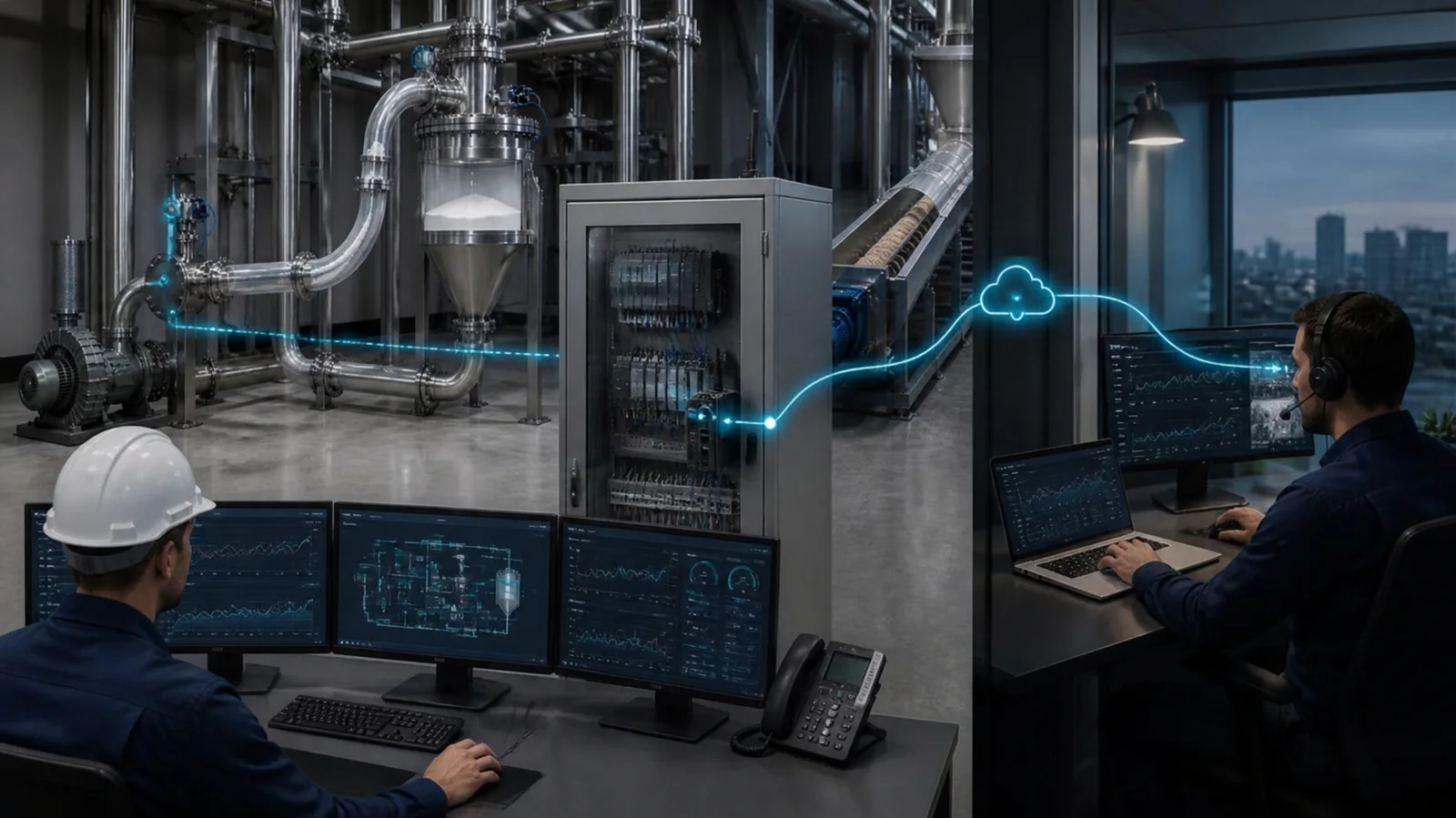
Remote support for process plants gives the supplier secure remote access to the plant's control system, so faults can be diagnosed, logic examined and settings corrected without waiting for a site visit. Combined with scheduled preventive maintenance and condition-based predictive monitoring, it shortens downtime and prevents small faults escalating.
How a maintenance deficit builds
Maintenance is a key factor in prolonging equipment life, minimising downtime and reducing cost in the long run. All too often it is overlooked until there is an emergency. The pattern is consistent: several small problems occur at once, none is urgent enough to stop production, and none gets addressed.
Those unaddressed cases accumulate into a maintenance deficit. It builds over time and eventually converts into unavoidable operational cost — emergency repairs at emergency prices, unplanned downtime at the worst moment, and a facility whose safety devices are no longer all proven to work.
The reasons periodic maintenance does not happen are rarely technical. Skilled resources are not available. The timing is never convenient, because the plant is always either running or being cleaned. There is no organisation or plan behind it. Or the benefits and costs of maintenance are simply misunderstood relative to the cost of not doing it.
Three maintenance strategies, not one
PTP works to a triple-P maintenance formula: pre-active, preventive and predictive maintenance. They are not alternatives — a plant needs all three, applied to different things.
Pre-active maintenance is about response. When a problem arises it is addressed immediately rather than ignored, because ignoring it causes production delay, costs more later and eventually affects profitability. It is the discipline of not letting a small fault become a deficit entry.
Preventive maintenance, delivered as an annual maintenance contract, is planned and routine rather than reactive. Inspections are scheduled to check the condition of equipment and parts, on the expectation that nothing should break down between planned interventions and that the intervention itself has minimal impact on production. Done properly it delivers maximum reliability and availability at the lowest maintenance cost, because the schedule is built around the specific technical needs of the equipment and the volume of production it carries.
Predictive maintenance is condition-based rather than calendar-based. Online techniques and plant data allow action to be taken at the right moment in the right place, resolving an issue on time and in the most economical way, instead of waiting for a fixed interval to come round.
What remote access actually changes
PTP remote support provides remote access for support and maintenance work, available 24 hours a day, seven days a week, and it can be extended to give the customer's own team remote access to their plant. The change it makes is to the first hour of a problem rather than the last.
Without it, a control fault starts with a phone call, a description of symptoms by someone who is not a controls engineer, and a wait for travel. With it, an engineer sees the same screens the operator sees, reads the alarm history, examines the logic state, checks instrument values and interlock conditions, and in many cases identifies the cause before anyone gets in a vehicle.
Even where a physical repair is unavoidable, remote diagnosis changes the visit. The engineer arrives knowing which device has failed and carrying the part, instead of arriving to begin fault-finding. That single difference is often the majority of the downtime.
What a system care contract covers
PTP's automation team offers a system care automation contract intended to address exactly the reasons maintenance gets deferred. It covers the health of PTP-supplied control panels, the plant control system itself, and the condition of field instruments — level sensors, limit switches, pressure transmitters, load cells — along with indicators and other safety devices.
It also includes basic training for plant operators and electricians, which is the part with the longest payback. Most avoidable calls come from a device that was misread or a condition that was not understood, and a plant team that can interpret its own alarms resolves a large share of issues without anyone else's involvement.
The service is defined rather than open-ended: a set number of automation expert visits each year and an agreed allowance of online support. PTP recommends the contract precisely because a defined schedule survives busy months in a way that good intentions do not — the exact visit and support allowance is fixed in the contract.
Getting value from it
Remote support works when the plant is instrumented well enough to be diagnosed. Level, pressure, load and position signals that exist in the control system are readable from anywhere; conditions that only reveal themselves as a noise or a smell are not. Where a machine matters and has no instrumentation, adding it is the enabling step.
Security is a legitimate concern and a solvable one. Remote access should be through a controlled, auditable route that the plant can enable and disable, with a clear record of who connected and what changed. A plant that cannot see what a remote session did will eventually stop allowing them.
The wider point is that support is an engineering activity, not an insurance product. Data from a running plant tells you which components actually wear, which alarms fire repeatedly and are silenced, and which part of the process is the real constraint — and that is the information a plant needs before it spends money on the next upgrade.