
Factory automation benefits
Automation in a powder plant is not about replacing operators. It is about making the plant behave the same way on a Tuesday night shift as it does during a commissioning trial.
In short
Factory automation integrates control across an end-to-end manufacturing process, using PLC-based control, instrumentation and interlocks to sequence equipment automatically. In process plants it delivers consistent output, less material waste, higher productivity, fewer quality defects from human error, safer operation around hazardous equipment and lower labour and energy cost.
What automation means in a bulk handling plant
Factory automation is the incorporation of automation across end-to-end manufacturing processes. In a bulk solids plant that means a control system that knows the state of every valve, feeder, blower and vessel, and sequences them so a transfer happens in the right order with the right interlocks. It is the difference between a set of machines with local starters and a plant that runs a recipe.
Concretely, it covers PLC logic and the operator interface, field instrumentation — level sensors, limit switches, pressure transmitters, load cells — motor control and drives, safety circuits, and the recipe and batch record layer above them. In manufacturing environments automation also leverages technologies such as pneumatic and hydraulic systems and robotic handling where the duty warrants it.
The reason it matters more in powder handling than in many other processes is that bulk solids are unforgiving of timing errors. Open a valve into a pressurised line, start a rotary valve before the blower, or begin a transfer into a silo whose vent filter is blinded, and the consequence is immediate and physical.
Consistency and quality
Unlike people, machines do not have off days or erratic break patterns, so results are constant and predictable. In a batching plant that consistency shows up directly in the product: the same addition order, the same mixing time, the same feeder trickle-to-target behaviour on every batch, on every shift.
Automation also removes a large class of quality defects that come from human error rather than human skill — a wrong ingredient selected, a step performed out of order, a mix run short because the operator was called away. Interlocks make the wrong sequence impossible rather than merely discouraged, which is a more durable control than training.
Beyond eliminating error, an automated process can be tuned. Once the plant records what it actually did on every batch, deviations become visible and parameters can be adjusted deliberately, batch after batch, instead of being adjusted by whoever is on shift.
Waste, productivity and running cost
With automation you calculate exactly how much of a material you need, and avoid having too much left over. In a powder plant that means dosing to target rather than to a comfortable margin, which reduces both giveaway and rework. Accurate weighing plus controlled feeding is where most of the material saving comes from.
Productivity gains come from streamlining and sequencing. An automated plant overlaps operations that an operator would do one at a time, starts the next transfer as soon as the interlocks allow, and does not lose minutes between steps. Over a shift, the recovered time is substantial and, unlike a capacity increase, it costs nothing to run.
Running cost falls on two lines. A PLC operates equipment according to the process requirement, so motors and blowers run when they are needed rather than continuously — and in a plant where the air movers are the largest loads, that energy saving is significant. Labour requirement falls too, though usually the more valuable outcome is redeploying skilled people from watching equipment to maintaining it.
Safety around hazardous equipment
Factories are accident-prone places, and the more the equipment can sense a developing problem and shut down accordingly, the more the risk is controlled. Automation greatly reduces the risk that operators face when handling hazardous equipment, because the routine interaction — opening a valve, clearing a chute, confirming a vessel is empty — moves from a physical act to a supervised one.
Interlocking is the mechanism. Access doors that cannot be opened while a rotor is coasting down, valves that cannot open against a pressure difference, conveyors that cannot start with a guard removed, and emergency stops that bring a whole train to a safe state rather than stopping one motor and leaving material in transit.
Safety functions belong in a rated safety circuit rather than in ordinary process logic. PTP control systems are built with CAT 3 safety circuits and are designed for safe entry into control panels, which matters because the panel is where maintenance staff spend their time and where the highest energies in the plant are concentrated.
What a well-built control panel looks like
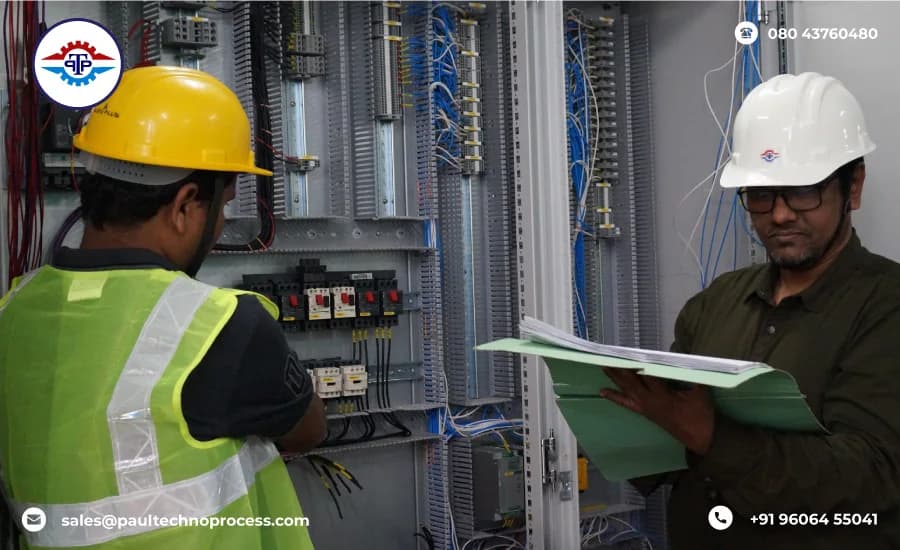
The panel is the part of an automation project that gets judged for the next twenty years, and it is where corners are most often cut. PTP control panels are designed for easy identification, with unique colour coding, spacious internal layout, CAT 3 safety circuits and safe entry for maintenance.
Each of those has an operational reason. Clear identification and colour coding shorten fault-finding at three in the morning, when the person in front of the panel did not build it. Spacious layout means a component can be replaced without disturbing six others, and it keeps heat down, which is the main cause of premature component failure in Indian plant rooms.
The last consideration is what happens after handover. Documented logic, labelled terminations, accessible spares and a maintainable structure decide whether the plant can be modified in three years or has to be reverse-engineered. Automation quality is mostly a legibility question.