
Components
Pipe fittings and couplingstri-clover, RJT, flanges, bends and ducting.
The unglamorous half of a conveying line. Fittings decide how fast it can be stripped for cleaning, how well it holds pressure and where it wears out.
In short
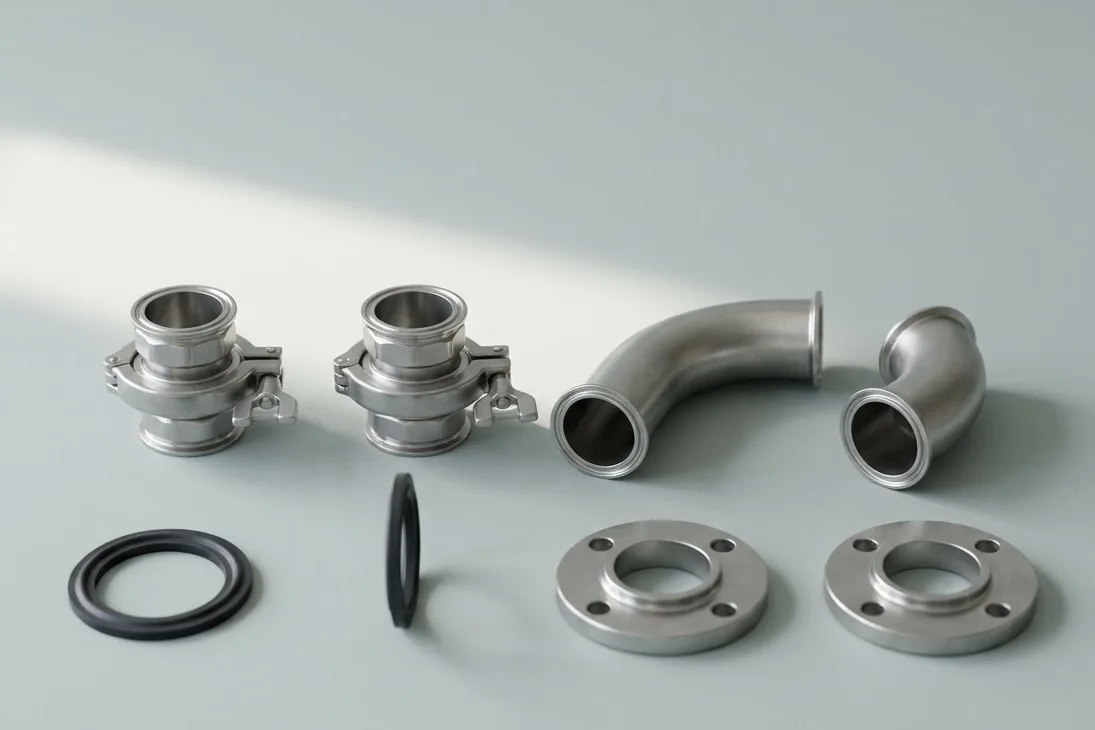
Pipe fittings and couplings are the connecting parts of a powder conveying or dust extraction line — tri-clover and RJT connectors, compression couplings, flanges, gaskets, long and short radius bends, stainless ducting and flexible connectors. They set how quickly a line can be stripped for cleaning and how well it holds pressure.
In detail
How it works.
Conveying lines rarely fail in the straight sections. They fail at joints and at bends, and both are fitting decisions. A joint that is awkward to open will not be opened during a cleaning schedule that is already tight, so product residue accumulates where nobody is looking. A bend chosen too tight for an abrasive product wears through from the outside of the curve and puts a hole in the line above a walkway. Neither problem is expensive to design out at the start.
Connection type follows the cleaning regime, not the pressure. Tri-clover clamp and RJT unions come apart by hand in seconds, which is what a line that changes product or is washed down regularly needs. Compression couplings and flanges are quicker to assemble and better where the run is long, permanent and not opened between batches. Mixing the two along one line is normal and correct — clamp fittings where hands go, flanges where nobody goes.
Bend radius is the single biggest wear decision in a conveying line. Long radius bends turn the product stream gradually, which reduces impact on the outer wall and reduces the damage done to a friable granule. Short radius bends are used where the route is genuinely tight, and they are the right answer for a soft, non-abrasive product in a congested plant. Where the product is abrasive and the layout allows it, long radius is nearly always the cheaper choice over the life of the line.
PTP supplies fittings and couplings on their own, which matters more than it sounds. Most of the fitting work on a plant is not a new line — it is a modification, an extra take-off, a replacement bend on a section that wore through, or a set of gaskets in a material the site cannot source locally. Send the existing connection type and size, the product, and whether the line runs pressure or vacuum, and the parts can be matched to what is already installed.
Scope
Types and options.
Selection
How it gets specified.
- Connection type
- Tri-clover clamp and RJT unions where the line is opened for cleaning; compression couplings and flanges where the run is permanent and stays assembled.
- Bend radius
- Long radius to reduce wall wear and particle damage in a conveying line; short radius only where the route is genuinely tight and the product tolerates the impact.
- Material and finish
- Stainless steel with a sanitary internal finish for product contact; mild steel or galvanised is acceptable for dust extraction ducting with no product contact.
- Gasket selection
- Matched to the product, the cleaning chemicals and the temperature, and to whether the joint sees positive pressure, vacuum or both across a cycle.
- Flexible sections
- Flexible connectors at machine interfaces so vibration and thermal movement are absorbed there rather than working loose the rigid pipework joints.
FAQ
Frequently asked questions.
What is the difference between tri-clover and RJT fittings?
Both are hygienic, hand-openable connections common in food and dairy work. Tri-clover uses a clamp over two flanged ferrules with a gasket between them, and comes apart in one movement. RJT uses a threaded union nut tightened onto a male part with a seal ring. Tri-clover is faster to strip; RJT is long established and widely stocked on older plants.
Long radius or short radius bends in a conveying line?
Long radius wherever the layout allows. The product changes direction gradually, so impact on the outer wall is lower, wear is slower and friable granules survive better. Short radius bends are for genuinely congested routes and for soft, non-abrasive products. On an abrasive duty a short radius bend can become the maintenance item that defines the line.
Can PTP supply fittings for an existing line?
Yes — most fitting supply is exactly that. Replacement bends on a worn section, an extra take-off, a set of gaskets in a material that is hard to source locally, or a length of stainless ducting. Provide the existing connection type and size, the product, and whether the section runs under pressure or vacuum, and the parts are matched to what is already fitted.
Where to next
Related pages.
Discuss your powder handling project.
Talk to an engineer.
Send the material, the throughput and the plant constraints. An engineer will come back with a route, not a brochure.