
Components
Industrial dehumidifiersdesiccant units for hygroscopic powders.
If a powder cakes in the hopper, bridges in the silo or blocks the packer on humid days, the problem is usually the air around it rather than the powder itself.
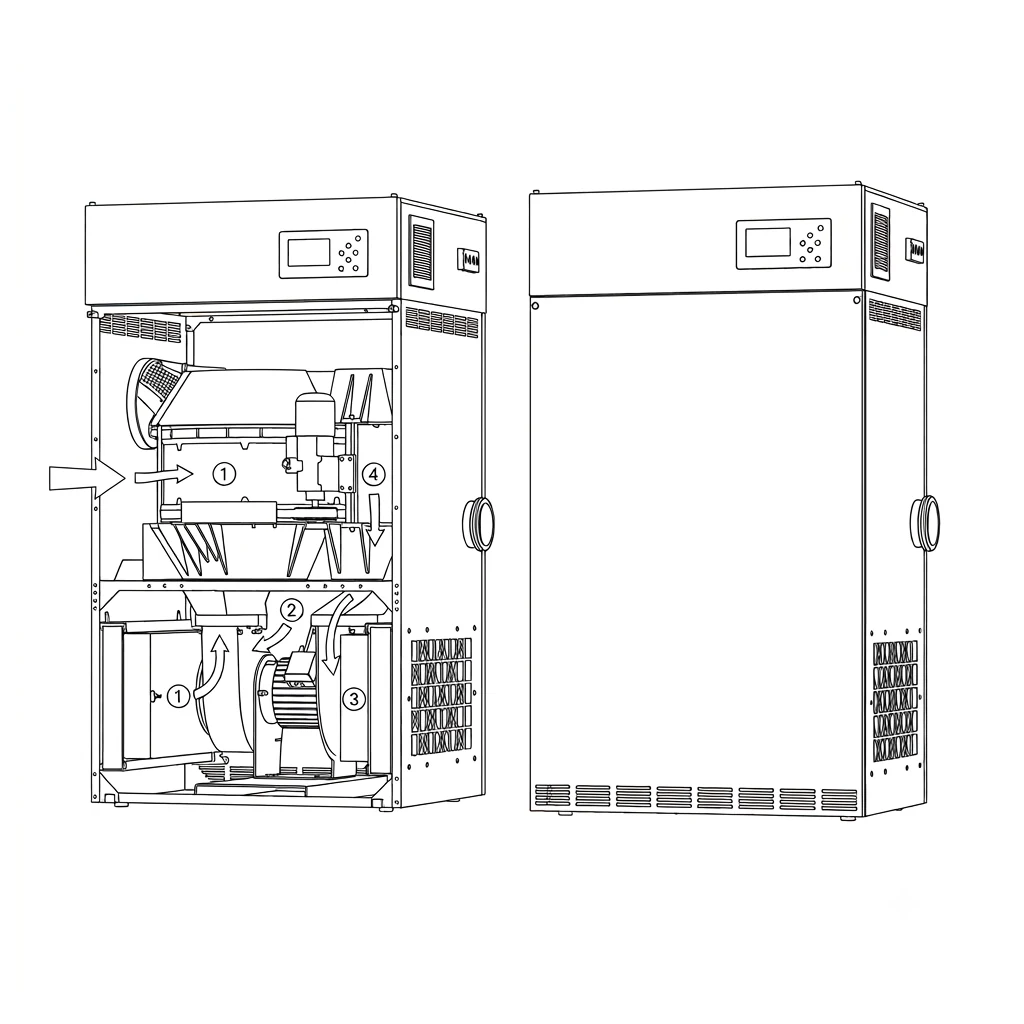
In short
An industrial desiccant dehumidifier dries the air supplied to a process by passing it through a rotor coated with a moisture-absorbing medium, which is continuously regenerated by a heated air stream. Unlike refrigerant units it keeps working at low dew points, which is what hygroscopic powders need to stay free-flowing.
In detail
How it works.
Hygroscopic powders take moisture from the air around them without anyone doing anything wrong. Sugar, salt, whey, starch, some pigments and a long list of pharma intermediates will pick up water from ambient air, and once they do the particles bond, the material bridges in the hopper and it stops flowing. In a humid climate the same line that runs cleanly in one season blocks repeatedly in another, which is why the fault looks intermittent and gets blamed on the equipment.
Desiccant and refrigerant units solve different problems. A refrigerant dehumidifier cools air below its dew point and drains the condensate, which is efficient in warm, wet conditions and gives up as the air gets colder and drier. A desiccant rotor adsorbs moisture directly onto a medium, so it keeps pulling the dew point down well past where a refrigerant unit stops being useful. Powder work almost always needs the desiccant type, because the target is a dew point rather than a comfortable relative humidity.
Where the dry air goes is a design decision with real cost attached. Conditioning a whole packing hall is straightforward and expensive, and it works because everything in the room benefits — the product, the packaging film, the operators. Supplying dry air directly into a silo, a hopper headspace or a conveying line is far cheaper to run and targets exactly the volume that matters, but it only protects the product inside that enclosure. Many plants need both, at different points.
Sizing is done from the moisture load, not from the room volume alone. Air changes, open product surfaces, door openings, people, wash-down and the moisture in the product itself all add up, and the required dew point sets how hard the unit has to work. Regeneration heat can be electric, steam or gas, and the honest selection criterion there is what the site already has available rather than what looks best on a datasheet.
Scope
Types and options.
Selection
How it gets specified.
- Technology
- Desiccant rotor units hold a low dew point in cold and dry conditions; refrigerant units are cheaper to run but lose effectiveness exactly where powder work needs them.
- Duty
- Room conditioning for a packing hall or powder room, versus dry air supplied straight into a silo, hopper headspace or conveying line.
- Sizing basis
- Set by total moisture load — air changes, open product surface, door openings, people and wash-down — and by the dew point the powder actually requires.
- Regeneration heat
- Electric, steam or gas, chosen against the utilities the site already has rather than against a headline efficiency figure.
- Control integration
- Dew point monitoring wired into the plant system, with interlocks so dry conditions are proven before hygroscopic product is exposed to the room or the line.
FAQ
Frequently asked questions.
Why does a powder plant need an industrial dehumidifier?
Because hygroscopic powders absorb moisture from ambient air and stop flowing. Caking in the hopper, bridging in the silo, blockages at the packer and lumps in the finished product are all symptoms of the same cause. Controlling the air around the product is usually cheaper and more reliable than adding vibration, aeration and manual intervention to fight the effect.
Desiccant or refrigerant dehumidifier?
Desiccant, for almost all powder work. A refrigerant unit condenses moisture by cooling, which works well in warm humid air and becomes ineffective as the air gets cold and dry. A desiccant rotor adsorbs moisture directly and keeps reducing the dew point past that point, which is the range hygroscopic powders actually need.
Is it better to condition the room or supply dry air to the equipment?
It depends on where the product is exposed. If it is open on a packing line, condition the room. If it sits in a closed silo, hopper or conveying line, supplying dry air into that volume is far cheaper to run and targets the actual risk. Plants with both exposures usually end up doing both.
Where to next
Related pages.
Discuss your powder handling project.
Talk to an engineer.
Send the material, the throughput and the plant constraints. An engineer will come back with a route, not a brochure.