
Dust-free processing in food plants
Hygiene requirements in food production are stringent, and airborne powder defeats all of them at once. It is a contamination route, an allergen carrier, a housekeeping cost and an explosion risk.
In short
Dust-free processing in the food industry means designing powder handling so dust is never released rather than cleaned up afterwards. It combines contained transfer, capture at every open point, hygienically designed collectors and ductwork that can be cleaned, and cleaning equipment that does not itself spread contamination between products.
What airborne powder actually costs
Dust in a food plant is four problems wearing one coat. It is a cross-contamination route, because powder that becomes airborne settles somewhere else — including on a line running an allergen-free product. It is a hygiene problem, because settled organic powder plus moisture is a growth medium. It is a safety problem, because flour, sugar, starch and milk solids are combustible. And it is money, because product on the floor was paid for and now has to be cleaned up and disposed of.
It is also an occupational exposure issue. Flour dust is a recognised respiratory sensitiser, and spice and enzyme dusts affect operators at low concentrations. A plant that has controlled dust for product reasons has usually solved the operator exposure problem at the same time.
The consequence is that dust control belongs in the process design rather than in the housekeeping budget. Every gram captured at source is a gram nobody has to chase across a production hall.
Contain the transfer before you extract
The cheapest dust to deal with is the dust never released. That means preferring closed transfer wherever the route allows it. Pneumatic conveying in a sealed pipeline releases nothing between the pickup and the receiver, and a vacuum system leaks inwards rather than outwards. An enclosed screw or flexible screw conveyor with proper seals and covers keeps material contained over short routes.
Dust is generated at the discontinuities: where a sack is tipped, where a big bag spout is opened, where a chute discharges, where a bag is filled, where a sample is taken. Each of those is a design opportunity. A bag dump station with an integral hood and extraction turns the worst manual dust source in the plant into a controlled one. A bulk bag unloader that opens the spout inside a sealed enclosure removes another.
Free fall is the enemy. Powder falling any distance entrains air, and that air has to escape from the receiving vessel carrying dust with it. Minimising drop heights, and venting the receiving vessel back to a collector rather than into the room, removes a dust source that no hood can fix afterwards.
Capture at source, and duct it properly
Extraction only works where the dust is. A hood positioned close to the generation point, oriented so the airflow follows the direction the dust is already moving, captures far more with far less air than a large hood placed conveniently. Enclose as much of the source as access allows; every side you can close reduces the airflow you need.
Ductwork does more damage to dust collection performance than collector choice. Transport velocity has to be high enough to keep food powders entrained — the light, cohesive ones settle readily — but not so high that it erodes bends or generates unnecessary fan load. Long horizontal runs with low points collect material, and once a duct starts holding powder it becomes a hygiene liability and, in a combustible dust plant, a fuel store.
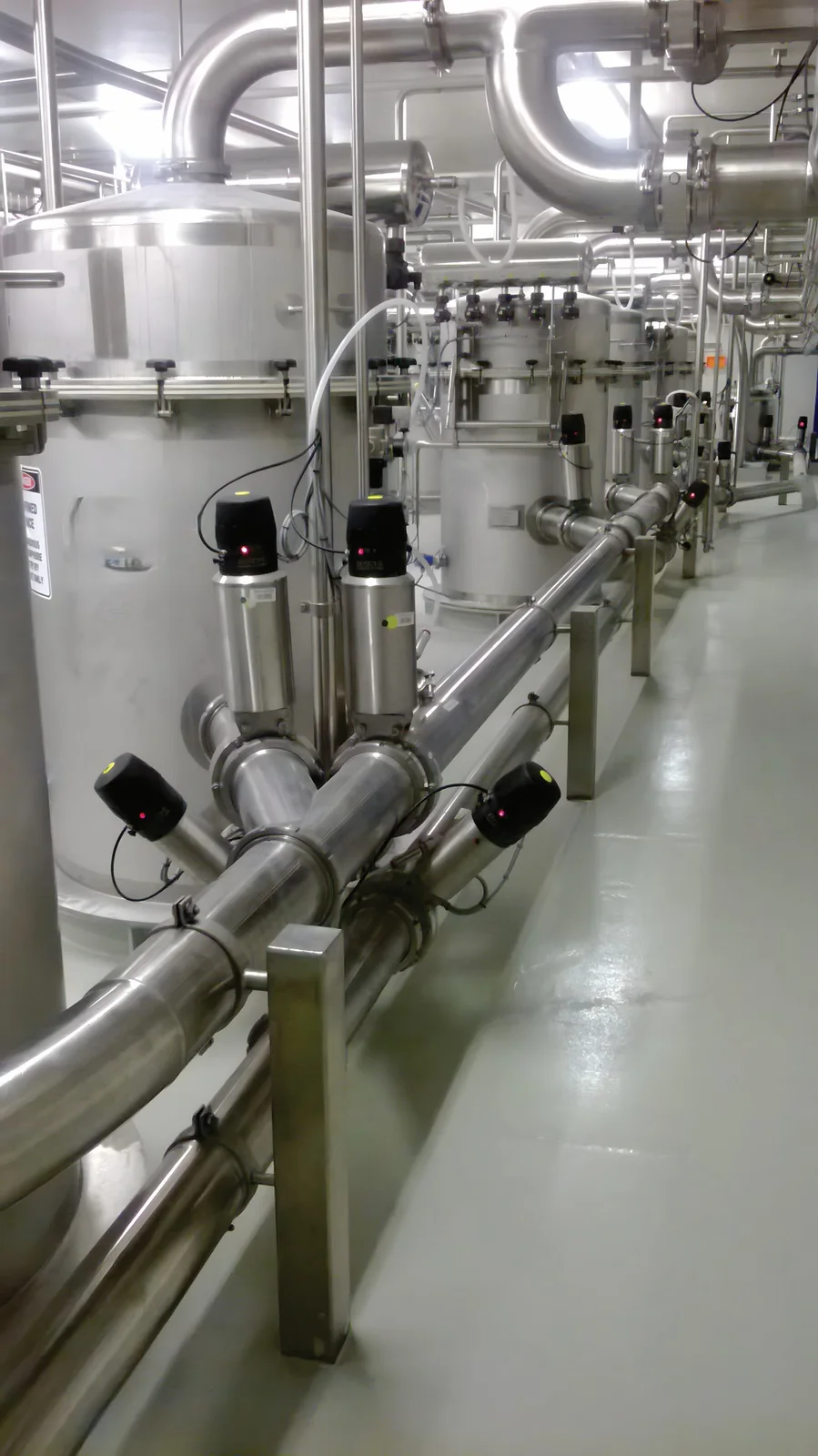
For food duty, ducting is designed to be cleaned: smooth internal surfaces, minimum joints, access points where deposits are likely, and a slope that drains rather than pools if it is ever wet-cleaned. Stainless steel ducting on the food-contact side is normal for the same reason the process pipework is.
Hygienic collector design and product recovery
A dust collector on a food line is process equipment. Its internals are in contact with product, so filter media has to be food-appropriate, seals have to be inspectable, and the housing has to be openable without showering the area with collected dust. Access from the clean side, as cartridge collectors usually allow, makes a change-out considerably less disruptive.
Individual collectors at each pickup point are often better than one central unit in a multi-product food plant. A local collector means the dust it captures is a single, identified product, which can be reintroduced into the process instead of discarded — worth doing where the powder is valuable. A central system mixes everything and forces the collected material to be treated as waste, and it couples every pickup point to one fan.
Combustible dust protection applies here as much as anywhere. The collector is where the plant deliberately concentrates dust in air, so earthing and bonding, venting or suppression where required, and isolation in the duct back to the process are part of the specification rather than an optional extra.
Cleaning without spreading contamination
Most food powder plants clean dry, because water plus organic residue is worse than dust. That makes the cleaning equipment part of the hygiene design. Centralised or portable industrial vacuum extraction with the right filtration removes dust rather than redistributing it, which is exactly what compressed-air blow-down does — it turns a settled deposit into an airborne cloud and a wider contamination area.
Cleaning tools cross contamination boundaries more often than any process equipment. Colour-coding brushes, hoses and accessories by area or by allergen status is a cheap and effective control. Tools that can be cleaned properly themselves, in materials that tolerate the cleaning method, and that are antistatic where combustible dust is present, are the right specification for food duty.
Finally, design out the places dust settles. Horizontal ledges on structural steel, on top of panels and on cable trays are where secondary dust accumulates, and they are the hardest surfaces to clean. Sloped tops, sealed penetrations and fewer flat surfaces above head height do more for long-term cleanliness than any amount of cleaning effort.